Author: M.P. Osborne

  • Is it landscape photography?

    Is it landscape photography?

    What do I do?

    Those who read my articles will know that I often struggle with terminology such as ‘landscape photographer’. For this article I thought I would explain my reasoning behind this, and how it can not only go deeper, but in an ironic twist also breed creativity and freedom.

    Labels are all around us. They can describe what we do: doctor, teacher, engineer or photographer. This is very helpful at parties as people generally understand most ordinary jobs. When it comes to photography, this description very rarely fits the bill. Being a landscape photographer differentiates from a portrait photographer, or a sports photographer, or a wedding photographer. In some respects, focussing in on a specific genre stops people asking if you can do some wedding photos if you’ve said you’re a sports photographer. However, unless you have already made a name for yourself, or have chosen a specific genre, for the most part defining your practice could pigeonhole you and restrict creativity.

    I experienced this first-hand photographing a tree. I do not consider myself a woodland photographer. If I had to really narrow down precisely what I photograph to tell someone as at a party, then I would probably come up with something esoteric such as an ‘environmental landscape & social documentary photographer (with a heavy dose of psychogeography underpinning it)’ to which people would look blankly at me, and I would follow up with ‘I take photos of spaces that people find boring’ and they would look awkwardly at the sausage rolls and make an excuse to leave. To avoid this, ‘landscape photographer’ is my general go-to, despite not really photographing what people would consider traditional ‘landscape photographs’.

    Because of this, it felt odd and strange to photograph this tree. In the wide sphere of photography it’s just another photograph, but it felt like I was cheating on my chosen creative niche. I half wanted a shopping trolley and traffic cone to be somewhere in frame to make it relevant. Landscape photography to a lot of people is a specific kind of photography that plays to their aesthetic ideals, usually based on a cultural hegemony to picturesque pastoral scenes. I’ve written about the picturesque before, I’m not sure I would describe my work as particularly picturesque which is where the disconnect happens.

    While I do term my work ‘landscape’ this goes against what people consider landscape photography to look like, which in turn means that ‘landscape photography’ – as far as the public are concerned – I feel doesn’t describe my work accurately. One rebuttal to this (without getting too deep theoretically) is that any photographs that are ultimately concerned with the land, and its subsequent use (or lack of) can be termed landscape photography. It’s just that to many people landscape photography is rolling hills, lone trees and pretty sunsets, not a derelict building or empty carpark.

    The second reason why it says landscape photography all over my website is Search Engine Optimisation, or SEO. Anyone whose spent any time around websites will know about SEO. To generalise it just makes your website easier to find on the internet. (I spent 12 years working on websites and SEO, so I picked up a few things). I use landscape photography as my main keywords to help people find my website. We unfortunately live in an algorithm-controlled digital world, and on the Isle of Wight there are a lot of landscape photographers. I consider my work to be just-about-close-enough if you squint to almost be ‘landscape’ (it’s not portraits, weddings or sport photography, so what else is there?) so people searching for ‘landscape photography on the Isle of Wight’ should come across by website. At least that is the theory.

    So, does this defining of practice matter? For an ‘unknown/still have the day-job’ photographer like me, I feel yes, it does. Do I like it? No. I’d much rather be just a ‘photographer’ or ‘photographic artist’ (I do quite like this one). Being just a ‘photographer’ doesn’t stop you from doing other things or limit your creativity, but people will ask you at parties if you can photograph their wedding.

    There are many ‘photographers’ out there. But the dichotomy is that you need to be specific enough to become well known to then stand out. Nadav Kandar takes beautiful photographs. Some of them are clearly landscapes, others portrait. He can do both but is known enough to do so. I was told at a university interview way back in the mists of time to specialise on one or two genres and not spread myself too thin. Personally, I think this is very good advice, especially to those starting out.

    Fine Art Landscape Photography Isle of Wight
    It is landscape?

    So where does this leave me?

    While I don’t particularly like to call myself a ‘landscape photographer’ I do admit that in the loosest of terms I am a photographer that photographs landscape as my main subject, just not the ones that most people think about. I also like to photograph other things, which sometimes end up being closer to what some may consider ‘fine art’ (although if anyone knows what this actually means, do let me know). Often I feel I’m photographing in a more documentry capacity, especially with work such as my Trollied project.

    At the end of the day, calling myself an ‘urban photographer’, ‘landscape photographer’, or ‘documentary photographer’ sets the tone for the work that people assume they’ll see when they view my work. Then when they do look at it, there is an odd disconnect between the assumption and the reality. Often, this is positive in the ‘I wasn’t expecting this, but I like it’, but it can still be an occasional curve ball to some people.

    At the end of the day, I’d rather just photograph what I want to photograph and to hell with defenitions. Yes, I enjoy photographs of empty car parks, run-down buildings and shopping trolleys, but I also enjoy photographing the sea – on an Island it’s pretty easy to do, and hope to produce more work along those lines. Since photographing that tree, I have wandered into the woods a few times, including a lovely (if cold) jaunt to get the creative juices flowing early last year. Maybe some woodland photography is on the cards after all?

    Not defining myself to a specific genre allows me to explore photographically the things that interest me enough to want to record them. It gives me the freedom to try new things and see what works. Woodland, seascapes, landscapes, abstract, documentary, environmental, social, history, urban, architectural – it’s all fair game providing I’m not trying to fit into a pre-conceived notion of what I should be photographing, but rather just going out and photographing enough to let other people decide for themselves what it is they are looking at. I’ve strarted to put up some more abstract work in my gallery, and I’d even love to have a go at some proper portraits (definitely not landscape), but that is probably a bit further in the future.

    So, what do I do?

    I take photographs.

    (Not weddings)


  • Finding Photographic Creativity with Limitations

    Finding Photographic Creativity with Limitations

    Like may creative people, I often suffer from a bit of a creative slump. This can manifest itself in just wandering about and not taking any photos or not taking any good (or even mediocre) photos. Personally, I find there are two effective ways to get myself out of this creative slump.

    The first is to go back to basics and read up on some lovely theory and see if there is any way of triggering some creative juices. Recently this tactic has made me come up with a new project that should see me though the next year or so, with the bonus of having some ‘grounding’ in critical theory. Not that this is always a consideration, I do believe you can take photographs for the pure pleasure of just taking photographs. My main impetus for taking photographs to start with often falls to just seeing what the resulting view/area/place/thing looks like as a photograph. Sometimes it works, sometimes not.

    The second way to get myself back into the swing of things is to go somewhere different and see if I can take any photos that I like. These I consider ‘practice’ photos. They are often not made to be shown, although one or two may make it onto Instagram. Quite often these practice photos will serve as a way of also honing my editing – both from an image selection and a literal editing of the raw files in Lightroom. Just playing about and seeing what works.

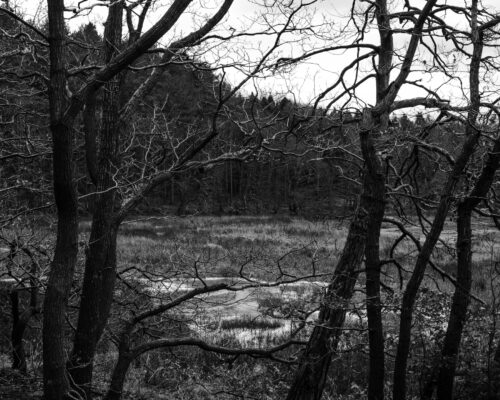
    In a lovely New Year creative slump in early January – probably bought on by the fact the sun had yet to make an appearance – I headed out to Firestone Copse, a wood a short drive away on a barely above freezing grey day with the sole goal to try and take some ok-looking photos.

    Finding photographic creativity with limitations in landscape photography

    While I generally call myself a ‘landscape photographer’ that is more a result of SEO management and laziness as I find it hard to make my work fit into a specific genre. Especially as someone who would like to be found on the internet or to briefly tell people what I generally photograph without them giving me a blank stare. I’ve mentioned my uncomfortableness of this a few times in the past, and it will be something I continue to grapple/figure out. For now, ‘landscape photographer’ it is, although my current work is only barely skirting with other peoples assumptions with this, especially as I generally don’t really photograph ‘traditional’ landscapes much.

    Anyway, I headed off to the woods and away from my usual urban psychogeographical wandering. Now I do love a bit of forest photography and appreciate Simon Baxter’s work and can quite happily watch his YouTube channel for a long time. It is definitely a skill capturing trees well, and something that in the future I’m not discounting, but it’s not my current subject (despite a photo last year of a tree), so heading to the woods was a little bit daunting. Especially as it was very cold, dark, grey, spitting with rain and unfortunately no fog (a pre-requisite for any decent woodland photos).

    Setting the limitations

    To try and counter this, I decided to give myself some limitations. I took the trusty XPro-2 with an unintentionally nearly flat battery so this was one limitation, but the main criteria were to shoot everything at 35mm, on a tripod, and using the B/W (Acros) Film sim. This was coupled with my own way of shooting which I’ve stuck to for a while now, and that is to only allow myself three frames in any location. My reasoning being if I’ve not got a good shot in three frames it probably still won’t be a good shot after 20. While the nearly flat battery was unintentional, it helped constain me further as I knew that it would run out at some point, it was just a matter of when so I had to make the most of the time.

    The 35mm focal length is not one that I generally use much. Most of my work is 23mm, but it was quite refreshing to work with the narrower FOV, and one that I would like to work with again. The B/W simulation was another new one. While I’ve shot lots of B/W film in the past, I’ve always converted the occasional digital shot to B/W which personally I’ve never been fully happy with as they seemed to always be a bit ‘muddy’. I have found that using the Fuji film profiles in Lightroom helps a lot, so I’m putting my past issues down to user error. Going out with a purely B/W mindset certainly took a bit of time to get back in to – thinking about tone and texture over colour separation.

    Taking the tripod was a way of slowing down. This allows me to think about what I am photographing, making sure I get my framing right and really concentrate on the scene in front of me before I trip the shutter. Again, this was a welcome departure to my usual loose, wandering way of working. I think I was out for about an hour and a half and managed about 40 frames.

    The photos

    As for the photos? Well, they are nothing special. I got some nice shots and some that I’m happy with which are illustrating this article. The aim of this jaunt was to work within some constraints, not to get portfolio-worthy shots. I do think that going to the woods and shooting colour, with a range of focal lengths without the tripod would have yielded less photos I like, and I think I would have learnt less, and ultimately not come away with a renewed sense of creativity.

    Rather than being limitations, these constraints do help to open the creative pathways and allow me to think differently. As previously mentioned, I try to always limit myself to three frames, which I believe has helped me hone my creative eye and stop me from just firing off frames at random. I personally feel that this allows more skill to come from knowing how or where to photograph something and knowing exactly when to trip the shutter than randomly firing off 10 or 15 shots in the hope of one good frame.

    Overall, this was a fun (if horrendously cold) experience and taught me a lot (even after 25 years photographing) about how I work and different ways to work in the future. Being more open to a 35mm focal lengths is one takeaway that I do want to use more, and the other – strangely – was to get back and shoot more B/W film, or even film in general. I do miss shooting film, but the cost is the only thing holding me back. My friend is shooting Ektachrome currently…

    Limit yourself and shoot more!

    February Update

    I admit that I have not posted up as much as I should recently. For 2025 I have some exciting things in the pipeline. While I don’t like to talk about things before they happen, I’m tidying up a project that I’ve been working on intermittently since the end of 2023 and have a new project in the works that I’m figuring out how to photograph.

    I also have a couple ‘academic’ articles that I’m currently writing, which I hope to put out in the coming months, and lastly, just to get out and shoot more – and shoot more film!

    As always, you can follow me on Instagram and I also post up on Foto – the new photography based photo app. Don’t forget that you can buy selected prints in my shop (there are also some more traditional actual landscape photos in there too).

  • The Tree

    The Tree

    Sometimes you have to just do things that feel right.

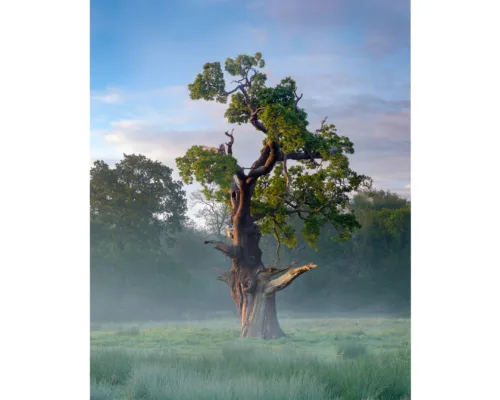
    I drive past this tree twice a day. It’s a rather nice, twisted old oak that stands alone in a field. It’s suffered a bit in its past, but still going strong. As the seasons changed, I noticed patches of bright green leaves appear and decided that it would probably make a nice photo. A nice morning one at that. Back in the early days of my photography I happily called myself a landscape photographer *. I would yearn for winter light and long late-spring shadows, heading to the coastline of the Island at every opportunity for the evening light. In my early 20’s I was not a morning person. Fast forward 20 years, I’m now very much a morning person (a 2-year old will do that) so thoughts of photographing a tree at 5:30am doesn’t fill me with a sense of dread.

    It was one particular 5:30am I decided that the weather was acceptable enough; high cloud in a mostly clear sky, and headed out to photograph this tree. Driving there I thought I could even get lucky and have a bit of low-lying mist. After parking nearby and a short walk to the tree, the sun had just about risen. Luckily the tree sits in a low-lying field with a wooded hill to the east, so I had more than enough time for the walk, scout about for where the sun would fall on the tree and realise I needed to waterproof my shoes from the dewy long grass before the sunlight hit the tree.

    As most landscape photographers will know waiting is part of the game, but within 10 minutes golden morning light started to light up the top branches, then slowly work down the trunk. The low-lying mist providing an extra ethereal quality. A few different views to cover all bases an as my watch ticked over to 6:30 I decided to head home for breakfast.

    The conditions had been perfect. However, on the way home I started to doubt my choice of subject matter. My early foray into landscape photography over 20 years ago ended up leaving me uninspired and disillusioned. Since then I have found my niche with a more documentary approach firmly grounded in photographic theory. Despite the lack of a picturesque aesthetic surrounding what I now consider my way of photographing, I feel I have a style. The tree however, I felt did not fit in with this.

    I decided to spend time processing the image. A lot more than my usual minimal approach. Even the Wacom came out. The result came out well; my wife wants it printed for the house and preferred it over my ‘boring’ photos.

    I was torn.  Making this image was an enjoyable process, from initial conception though to the final image, but I also felt that it was too left-field compared to anything I’d shot in the last few years. I sat on the image. Pleased with what I had taken, but not sure what to do with it.

    Fast forward a couple of weeks and I ended up on YouTube watching a little video by Peter McKinnon. In it he went out to photograph a sunrise – a subject that he would usually not photograph – but thought about it as a sort of ‘creative reset’, just going out to photograph something just because you want to and to have some fun. This made me think about the tree photo a little bit differently. Does it fit in with my current practice? No. Did I have fun making it? Yes. Did I enjoy the process? Yes. Do I think it’d hurt my (I must admit, very, very low-key) recognition for what I do? Extremely doubtful. Even Martin Parr shot fashion.

    Now I can think of my tree photo as a fun shoot, a mental and creative reset. It was refreshing to be out early surrounded by trees and nature. It felt right to photograph it. At the end of the day, I am pleased with my image. Even if it doesn’t fit in compared to my other work. My wife likes it enough to want a large print of it, so at least we will have a nice photo of it up in the house. Until I can persuade her a shopping trolley in a puddle commands the same attention that is. Who knows, maybe I’ll be known for tree photography…


    *You are on a website with the tagline is ‘landscape photography’. Generally I sort of consider myself a landscape photographer, however as I’m sure you’ve probably figured out by now, they are not the ‘traditional’ picturesque landscape photography that people generally first think about. Honestly, even ‘Photographer’ is probably pushing it, but unfortunately we live in an algorithm controlled world where specifics help, and landscape photographer works better as a definition. 


  • Landscape photography and the Picturesque

    Landscape photography and the Picturesque

    This is my third attempt to write this post and has taken nearly a year to finish. One of the reasons has been research. I have been reading a lot about landscape. Both as a photographic subject but also landscape in and of itself from a geographic point of view. The sticking point is the middle ground, where photography, geography, identity, culture, and place meet and that’s before we even think about getting philosophy and art history into the mix. I perhaps naively thought writing about landscape photography would be easy. It turns out it is very hard!

    For this post I have attempted to get over some thoughts that I’ve been having on landscape photography but in reality, I am barely scratching the surface. I feel that this subject deserves a lot more than a single post, but in researching this I have learnt a lot and continue to learn. I hope this also feeds into my own practice too.

    When I started photography in the late 90’s, I wanted to be a mountain bike photographer. This unsurprisingly proved to be a lot harder than anticipated on a small island. After realising that mountain bike photography was probably not going to work for me, I ended up labeling myself a ‘landscape photographer’. Living somewhere that is very pretty, taking and selling landscape photography is a bit like shooting fish in a barrel. I sold prints and even had a few published in the mid-2000’s. There are a lot of landscape photographers on the Isle of Wight. Some that I looked to for inspiration 20 years ago are still going strong, others carved out their own niche much later. All of them work hard to make a living from photography, especially in today’s tricky economic times.

    However, I soon became dissatisfied with the work I produced. Low evening light, dramatic sky, all the elements perfectly composed and the rule of thirds – were to me, just going through the motions or following a script on how to take a picturesque landscape. They were technically good, but I was really struggling to enjoy the process. In fact, landscape photography generally was leaving me cold. I looked in the shop windows of photographers I admired years before and found myself appreciating what they did, I didn’t wholly like it, as if something was missing.

    Over the subsequent years I did mostly commercial photography and hardly ever took any landscapes. This took a change on my BA. Art History is a wonderful subject, and gave me a new appreciation and understanding of art. For one unit we looked at photography in colonial India. I bought a book – ‘Afterimage of Empire: Photography in Nineteenth Century India by Zahid R. Chaudhary. This book helped me to understand landscape photography in a completely different way. I realised that my tastes had changed from the purely aesthetic and picturesque to something deeper. Studying the photographs of Felice Beato and Lala Deen Dayal (and others) taught me to look and photographs and find meaning behind them. I am looking for a narrative, a series of questions: ‘Why did the photographer choose to photograph this?’. ‘What are they trying to tell me?’. ‘What can I learn from this photograph?’.

    Finding Landscape Photography

    Realising this was my eureka moment. I sought out images that challenged me, discovered new photographers, and learnt to understand and appreciate landscape photography anew. In doing so I have spent the last few years learning about landscape. How we react to it, and interact with it. How this is recorded, documented, interpreted, understood and impacts on our own lives and culture. I even changed the way I photograph to incorporate this way of thinking. In a previous post I wrote about psychogeography which helps me to think about landscape as an artist and practitioner and to better my own work. The practice of psychogeography comes out of Marxist Aesthetics, but there are other more familiar terms that have an equally – if not more – in-depth theory or theories behind them. The first of these is the picturesque.

    This may seem an innocuous word, meaning essentially attractive like a picture. This is a word often ascribed to a place which is why it’s often used to describe views; Place A is picturesque, therefore a picture of it will be picturesque. When it comes to landscape photography, it is usually the picturesque that instantly draws people in. It appeals greatly to our aesthetic tastes. This is the landscape photography of many calendars and adorns many walls around the world. It is the archetypal sunset or sunrise, long shadows, and wide vistas.

    I would like to mention, that I do not have a problem with this type of photography. As mentioned at the start, this is what I used to do. Getting a good shot is not easy and requires a lot of planning. Waiting for the right light, often the right season, and hoping the weather cooperates for that five-minute window.

    For me though, this type of photography, while beautiful to look at, generally does not push my knowledge or understanding of a place. Mind you, this is usually not the photographer’s intention, so we must tread lightly in looking for meaning. From my own experience, I used to photograph scenes that I felt were picturesque in the hope that others would see them and would appeal to their own aesthetic tastes. I was taking a photograph for the ‘wow’ factor, hoping that my photograph and thus my experience of a place could be shared but never replicated. However, as my tastes changed, I realised that chasing my own idea of the picturesque was not what I wanted to do. It was not how I wanted to take photographs.

    The landscape photographer Fay Godwin in a BBC Southbank Show commented:

    I am wary of picturesque pictures. I get satiated with looking at postcards in local newsagents and at the picture books that are on sale, many of which don’t bear any relation to my own experience of the place… The problem for me about these picturesque pictures, which proliferate all over the place, is that they are a very soft, warm blanket of sentiment, which covers everybody’s ideas about the countryside… It idealizes the country in a very unreal way (Godwin, 1986).

    This quote may seem harsh but picking it apart it is critiquing not the photographer who chooses to photograph the picturesque, but the pictures themselves which do not accurately reflect the experience of being there. Picturesque pictures could be termed hyperreal, which philosopher Jean Baudrillard defines as “the meticulous reduplication of the real, preferably through another, reproductive medium, such as photography” (Wolfreys et al, 2006). These pictures then align more with how we think a place should look. For example, a place that has been designated as ‘picturesque’ (I often wonder who decides this) with lots of postcards or tea towels for sale idealizing (to use Godwin’s parlance) that place. People then visit these places with a preconceived notion of what they should see and are often disappointed when faced with the reality.

    Chasing the Picturesque

    From my own experience chasing the picturesque, I was trying to photograph an unrealistic version of what I was feeling at that moment in that specific location. I was not happy with the results of my photography because it was not how I experienced it at the time. Looking at other’s photographs I felt the same. My personal experience of, let’s say a sunset at Compton Beach, was vastly different to the photographer’s when they took their photograph.

    Going deeper, what is this photograph of a sunset at Compton beach showing me, apart from playing to my own (and perhaps others) preconceived ideas about what it should look like? A Hyperreal version? What other information can I take from this photograph that I have not seen or experienced for myself? Even as far as what is the photographer saying with this photograph; about themselves or the place that they are recording? Professor of photographic culture Liz Wells states, “Photographs substitute for direct encounter; they act as surrogates, mediating that which was seen through the camera viewfinder” (Wells, 2011). This is how we as viewers understand a place we have never been to. A visual representation of a thin slice of geography framed between two edges of a photograph.

    However, is it the photographer that then chooses how to represent this slice. I found that by choosing to photograph the picturesque I was essentially missing out on a lot of information that would help a viewer understand the place better, including things I could not capture; the sounds, smells or temperature, which could help better describe the experience of that place. Herein lies another question: Whom is the photograph for? A picturesque landscape will appeal to a lot of people as it would probably align with their idea of what an ideal landscape should look like, based on their preconceived ideas of what a landscape is, more so if they are familiar with the landscape represented. Using the photograph as an aide-mémoire to recall their own experience of the place depicted.

    Many landscape photographers try and seek out a picturesque view with good light and compose according to long-standing traditions of composition. However, Robert Adams postulated a different set of ideas which needed to be balanced as a whole to produce meaningful landscape photographs: geography, autobiography and metaphor. (Adams, 1996). I agree with Adams’ analysis and see purely picturesque images as too weighted in favor of the geography – regardless of how pretty the sunset is. Autobiography is how the photographer can use the image to reflect their own thoughts tastes and values. But the metaphor is where I believe the interesting things happens. This is what makes the photograph go from a mere picture, to a deeper visual narrative.

    However, as Deborah Bright comments ‘whatever the aesthetic merits, every representation of landscape is also a record of human values and actions imposed on the land over time’ (Bright 1989). It’s hard to argue with this considering every landscape photograph is also a record of the landscape. In photographing it, the photographer is not only recording it, but also saying that they were there. Landscape photographers form representations of the place which can be interpreted by the viewer. It also ties the landscape to culture, but that is for another post…

    The Picturesque

    Personally, I feel that the picturesque is an interesting concept within landscape photography. Its roots can be found deep within art history, and its prevalence in the myriad photographic postcards and pictures sold every day show that there is a market for these types of photographs. Picturesque photographs could be interpreted as a hyperreal version of preconceived ideas surrounding a particular place that aligns to the aesthetic tastes of an audience. For myself these photographs can and do look nice, but do not go deeper, and that’s where I feel photography starts to have an impact. Thinking about Robert Adams’ ideas behind the elements that can make up a meaningful landscape photograph, these are the elements that I feel allow landscape photographs to tell people what the photographer is trying to say with their work. In effect, as Deborah Bright comments, this recording is more important than the aesthetic consideration (although this can help).

    I am still at the beginning of my learning about landscape photography, but the journey is as exciting as it is daunting. As I have discovered, the landscape photography rabbit hole is very deep and quite intense.


    Adams, R., 1996, Beauty in Photography, New York: Aperture

    Bright, D., 1989, ‘Of Mother Nature and Marlboro Men: An Inquiry into the Cultural Meanings of Landscape Photography’ in Bolton, R., (ed) The Contest of Meaning. Cambridge, Massachusetts

    Godwin, F., 1986, in Alexander, J.A.P., 2015, Perspectives on Place: Theory and Practice in Landscape Photography. London/New York: Routledge

    Wells, L., 2011, Land Matters: Landscape photography, Culture and Identity. London/New York: Routledge

    Wolfreys, J., R. Robbins and K. Womack, 2006, Key Concepts in Literary Theory. 2nd Edition. Edinburgh: Edinburgh University Press

  • Psychogeography & Photography

    Psychogeography & Photography

    What is it all about and what does it mean for photographic practice?

    I first came across the term psychogeography on my MA from one of our lecturers, Dr Sebastiane Hegarty, who was organising some psychogeographic walks around Southampton. Unfortunately Covid stopped that, but I never stopped thinking about psychogeography. It seemed an interesting term for essentially thinking about the built environment as you wander through it.

    So where does this term come from and what the dickens does it have to do with art and photography?

    Psychogeography – the beginning

    Before we get into the specifics, we need to do some (hugely simplified) background work. This comes in the form of two German philosophers, Karl Marx and Friedrich Engels. Marx and Engels wrote critical theories on politics, economics and society, which was termed Marxism by another German philosopher, Karl Kautsky. Marx and Engels co-developed communist theory, publishing ‘The Communist Manifesto’ in 1848. It’s this socio-political branch of Marxism that people are most familiar with, but there are many branches to Marxism that are less political. The branch we need to look is termed Marxist Aesthetics.

    Marxist Aesthetics

    As Gordon Graham argues in his Marxist Theory of Art (1997), that critical art theory can be broken down into two distinct and opposing thoughts; Philosophical, which goes back to the minds of Plato and Socrates, and Sociological, which traces its roots back to Marxism.

    The aim of the sociological approach is to understand art as an historical phenomenon and a social construction, and it is Marxist theory which sets the terms in which this is to be done (Graham, 1997).

    Marxist Aesthetics then is our starting point. As Marxism spread around Europe, artists, writers, philosophers, intellectuals and political thinkers, started to form organisations whose thinking was influenced by Marxism. In the mid 20th Century, one of these organisations was ‘Letterist International’, formed by Guy Debord and Gil J. Wolman in 1952 as a breakaway from the French Avant-Garde group ‘Letterists’ which had formed in the 1940’s. Their ‘official’ address in Paris was a bar which allowed the group freedom to wander the streets of Paris. From this wandering the term dérive was coined, being ‘a mode of experimental behavior linked to the conditions of urban society: a technique of rapid passage through varied ambiances (SI Online n.d).

    In his Introduction to a Critique of Urban Geography, in which psychogeography is first introduced, Guy Debord first sets out his definition of geography:

    Geography, for example, deals with the determinant action of general natural forces, such as soil composition or climatic conditions, on the economic structures of a society, and thus on the corresponding conception that such a society can have of the world (Debord, 1955).

    It was from this practice of dérive mixing with the impact of geography on society and the environment of the city that bore out psychogeography.

    Psychogeography could set for itself the study of the precise laws and specific effects of the geographical environment, whether consciously organized or not, on the emotions and behaviour of individuals (ibid).

    Psychogeography then, could be defined by the influence of the environment on the people who interact with it. What is interesting to note is that this definition doesn’t limit itself to purely a built or urban environment. While it was borne out of the streets of Paris through dérive which was specifically linked to urban society, it could be argued that psychogeography is not necessarily environment specific. One could practice psychogeography anywhere, from the centre of a large city to the open wilds of the countryside. However, a longer description as to the reason behind psychogeography appears that puts this on shaky ground:

    The sudden change of ambiance in a street within the space of a few meters; the evident division of a city into zones of distinct psychic atmospheres; the path of least resistance which is automatically followed in aimless strolls (and which has no relation to the physical contour of the ground); the appealing or repelling character of certain places — these phenomena all seem to be neglected. In any case they are never envisaged as depending on causes that can be uncovered by careful analysis and turned to account (ibid).

    This re-links it back to a practice for a specifically built environment. I would still argue that this could still not necessarily be the case. It’s just that a city would have a much greater influence than a small rural village. While dérive was concerned with a rapid passage through this (urban) environment, psychogeography is the opposite. Slowing down and noticing the nuances, the specific changes in the environment or ‘psychic atmospheres’ that could mean one area goes unnoticed, while another makes people congregate there for whatever reason. In effect, psychogeography is concerned with noticing and identifying these areas, and at the same time using them as points to link others together.

    A psychogeographic walk then, should not necessarily be a planned walk, but, as Debord states, is taking ‘the path of least resistance which is automatically followed in aimless strolls’ (ibid). In effect allowing the environment to guide you subconsciously around it.

    Practising psychogeography

    So how does psychogeography work as part of a wider artistic practice? Well, this depends a lot on your practice. Aimlessly wandering about in search of ‘psychic atmospheres’ can sound a little bit too much in the same realms of astrology and fortune tellers. We already have a good understanding of what psychogeography is, but the last few words – ‘careful analysis and turned to account’ are key.

    Making an account of what you see or find, or recording your specific feelings or observations that a place or space gives you. It almost makes psychogeography a sort of science: Observe an environment, analyse it and record your findings. If you can count any preconceived notions as to why an environment could be as it is like a hypothesis to test, then it almost is. This way of looking at things is quite clinical, but it is in essence what psychogeography is. Recording the findings is where artistic practice meets the practice of psychogeography. Whether writing, poetry, drawing or in my case, photography. Psychogeography is a mode to help artistic endeavour.

    Psychogeography and photography

    My own artistic practice started out a bit confused. As I leaned into landscape photography, I discovered an area of photography that I enjoyed, and that did make some commercial sense. However, landscape photography while enjoyable, always left me a bit cold. While I can appreciate the skill in capturing a particular scene and the resultant aesthetic qualities, I always found that my photos were lacking something. They were showing an ideal, almost hyperreal version of a place. They never explained or dealt with any real issues. They nearly always concerned themselves with the natural environment and shielded away from the social or economics of a place. This is why I found myself continually drawn to more documentary style photography. While documentary photography has its own share of problems, I found they offered a lot more depth. Mixing genres to create, ‘landscape documentary’ or ‘social documentary’ would probably most likely define my own practice better, but there is also argument for not even defining my practice (I’m not even sure ‘photographer’ is truly representative).

    Psychogeography allows me to ground and frame my work within this middle ground of social documentary/landscape. This is at least how I see it; others may have their own take on it. Wandering around, letting the landscape – urban or rural – guide me and photographing (making an account, to link in to Debord’s text), what I find interesting either social, aesthetic or incongruous. Both the appealing and repelling character of a place.

    Whilst on my MA and being introduced to the practice of psychogeography, I also – as any good Masters’ student should – did some extra reading. W. G. Sebald’s excellent Rings of Saturn is a wonderful read, framed around the author’s long walks round East Anglia. In it he discusses art, history, philosophy and landscape with intertwined stories and accounts. I’ve also read Ian Sinclair’s Lights out for the Territory. A well known practitioner of psychogeography, Sinclair takes us on a series of walks around London. Like Sebald, this has many intertwined stories linking through with the walks. Sinclair also likes to place in phrases from graffiti, posters, or random words that he’s collected on his walks, Grounding his psychogeographical accounts.

    Personally, I see psychogeography as a helpful tool that I can fall back on to find inspiration. Like most things however, there are some issues with it. The primary one that I have touched on is that it is seen as a practice that is rooted in an urban environment. I can understand this, but likewise there is no real term for exploring a more rural setting without accidentally ending up taking bad landscape photos. ‘Rural psychogeography’ seems to appear in internet searches but makes the separation between them even more obvious. Falling back on Debord’s original definition makes no specific claim to being an urban or rural practice. To my mind, psychogeography is the exploration of space and place and how this can affect individuals, this can be urban or rural.

    In the digital world, the likes of Instagram has made #psychogeography an interesting repository of what this means to others. It is exciting to see how different people see and record their own corner of the world. I do feel that to work at its best, psychogeography of a particular area or space is best seen as a whole body of work rather than individual photos. However, this is more an issue with Instagram as a platform rather than with psychogeography as a practice.

    Psychogeography is an interesting concept. It’s become more prominent since the Covid lockdowns, but hopefully this means more people out and about, noticing things. It’s about discovering and recording our sense of place, and there is nothing wrong with that.


    Debord, G., 1955, Introduction to a Critique of Urban Geography.

    Debord, G., 1958, Theory of the Dérive in Situationist International Online (https://www.cddc.vt.edu/sionline/si/theory.html)

    Graham, G. (1997). The Marxist Theory of Art. The British Journal of Aesthetics, 37(2), 109–117. https://doi.org/10.1093/BJAESTHETICS/37.2.109


    W.G. Sebald, on Amazon

    Ian Sinclair, Lights out for the Territory on Amazon

  • Photography and Fatherhood

    Photography and Fatherhood

    I am now also posting on Substack! – https://mposborne.substack.com Do sign up to receive new posts straight to your inbox.

    Photography and Fatherhood – Thinking about how photography links the generations.

    In June 2022 I became a father. This was understandably a huge event in my (and my wife’s) life. What with the sleepless nights, nappies, and generally being on 24hr duty for our baby boy, thoughts of photography were put aside for a few months while I became accustomed to my new role in life.

    When I eventually got back to taking photos, it was without the baby. The logistics in the early days just didn’t work. As he passed the sixth-month mark and we settled into our new house, I started to take the baby out in his pushchair on walks that were essentially for me to take photos. It was great. I could spend some one-on-one time with my son – even if he has no idea what I’m doing. He loves being outside looking at things, and his mum can have a well-earned break for a couple of hours. I occasionally get a decent photo out of it too. I also take a few of the baby which is always nice. Having him around on photo-walks helps me think about the process more. I talk to him about light, angles, compositions, and he just sits there and looks at me like I’m strange. I’m looking forward to when he’s old enough to carry my camera bag.

    My whole relationship with photography stemmed from my father. Not that he got me into photography. He was a ‘keen amateur’ in the late 70’s and early 80’s, photographing lots of things around Yarmouth where my Mum and Dad first lived when they moved to the Isle of Wight in the mid 70’s.

    The relationship I had with my father was one that can only be summarised as ‘complicated’. Without going into too much personal detail, he wasn’t around too much in my teenage years.

    My dad used a Mamiya 645j and a Contax 139 as his cameras. I found the Contax in a draw under the stairs sometime in 1997 and emailed him to asked if could use it. He told me there were a few books on 35mm photography somewhere, so I found those and set about learning about this photography lark photographing my friends mountain biking. My dad was a very technical person which I think is why photography suited him. He designed radar systems for Plessey/BAE and went around the world setting them up. He knew about the technicalities of photography, but what few conversations we had about photography, none of them were ever on other photographers or discussing photography in any great depth.

    I then came at photography from this technical angle. Making sure that the aperture and shutter were just so, the flashes were positioned and set correctly to balance with the light. All on film. Things like composition were a secondary consideration, but I soon learnt what worked and what didn’t aesthetically, even if from a technical standpoint things were ‘correct’.

    My father passed away in 2007. I never went on photography trips with him or had any discussions about his photography. All I have are his cameras, darkroom equipment, and a large box full of thousands of slides and prints showing carnivals, sailing, fireworks, social parties, local events and the odd wedding from the early 80’s. I hope to go through it properly one day. Looking back, it seems odd that I have become so invested and all-encompassed by photography, which to my father was only a hobby alongside cars, shortwave radio, and sailing.

    I’m still not sure why he stopped photography, or even why he started. I’d probably have taken it up sooner if he’d shown me how to process pictures in the darkroom (I still find it a bit magical). His stopping does co-inside with the births of me and my sister in the early and mid-80’s. Maybe for him, children were what stopped his hobby. Or he just simply decided the photography was done with as his life moved on. Which makes my passion for it a touch ironic.

    Forty years passed between my dad becoming a father and me becoming one. The social responsibility of what a father is expected to do in that time has changed dramatically (for the better). My father was a ‘hands off’ father, which I don’t think was all that strange in the 80’s, but his idea of being a father and mine, from what I remember growing up, are vastly different. I really want to involve my son with my photography – and anything else I do for that matter. If he ends up loving it, great, if not then I’ll still bore him talking about art and photography. He’ll have no choice. I realise I am more ‘into’ photography than my father ever was which could be why I can’t think why I would ever give it up, and I want to include my son as much as possible.

    While not really being something that one can have as hobby, I also have an interest in psychology. Looking at my relationship with my father, it is very conceivable that I am using photography as a connection to him, in a way to try and understand him more. Maybe 16-year-old me thought that photography was something that I should do because my father had done it, to try and make him proud of me. It was also my complicated relationship with him that has made me always want to better myself. I was contemplating going to university to do photography just before his death, he said it wasn’t needed, but seemed somewhat interested. I have no idea what he’d make of my Master’s degree. (Probably still say it wasn’t needed), or that I’d like to take my theory work even further.

    The essayist Susan Sontag famously wrote that All photographs are memento mori’ (Sontag 1979). This has been quoted by many a photography student (me included) to discuss the power a photograph has by stopping time and preserving what was in front of the lens. At the same time reminding us, the viewer, that the moment has passed and can never happen again. Reading further, Sontag continues:

    A photograph is both a pseudo‑presence and a token of absence. Like a wood fire in a room, photographs – especially those of people, of distant landscapes and faraway cities, of the vanished past – are incitements to reverie (ibid).

    I personally feel this quote is more inciteful as to the power of a photograph to make the viewer feel intimately connected to it as a record of something, or someone that no longer exists, especially if there is a personal connection. As I discussed in my Master’s dissertation on pose in portrait photography, Sontag’s famous quote frames the photograph as a reminder of death. However, as the latter quote suggests, photographs are better served as a reminder of absence, that someone lived and seems to continue to do so though that photograph.

    Taking this further, thinking of photographs as objects, not just records of a subject, a photograph can remind us not only of what’s in the picture, but also that someone took that photograph. An invisible author who decided that what they saw was worthy of recording, capturing a moment in time that could outlive them. As a father, through the monumental joy of having a child soon comes a sobering melancholy that your child will outlive you. It is this thought that makes me want to involve my son in what I do before he finds his own path in life.

    I have very few photographs of my father, but through the photographs he took and the cameras he took them on, I am reminded of him. As academic Marianne Hirsch comments, ‘photographs provide perhaps even more than usual some illusion of continuity over time and space’ (Hirsch 1997). While we didn’t have the closest of relationships, I feel strangely comforted that it’s through photography, even if separated by many years, that we can finally share an interest.


    HIRSCH, M., 1997. Family Frames: Photography, Narrative and Postmemory. Harvard:
    Harvard University Press

    SONTAG, S., 1979. On Photography. London: Penguin


  • Photography and A.I.

    Photography and A.I.

    The last year or so has seen an explosion in A.I. technology being reported in the media. What was once seen as science fiction, has, over the last couple of decades, become more prevalent and more widespread. Most people by now would have heard about Chat GPT on the news. This technology is exciting, but also raises serious questions how best to integrate this into our lives, or even if we should. While the pitfalls and positives are now being debated, I have been thinking about how this can affect our photographic practice. How will the photography world embrace A.I.? Will it be for good or ill?

    Most photographers using Adobe products in the last few years may have come across their A.I. processing tools, which, in the right hands open many new opportunities for processing digital images. Not liking a bland blue sky? A.I. will now replace this with a beautiful sunset. Adobe have been advertising Photoshop as the ‘worlds most advanced A.I. app’ since late 2020, and for those invested in the Adobe ecosystem, it is hard not to be impressed even if those features are not necessarily part of your workflow.

    I first encountered the power of what A.I. could do from being sent a link, showing at first glance, images typical of the style of Victorian photographs. As someone who has researched Victorian photographs extensively, they looked nothing out of the ordinary. However, they were all generated using the A.I. software Midjourney by artist Mario Cavalli. I was surprised by the accuracy of the images. It was only on close inspection of a few images did the inaccuracies start to show. This excited me, not only by what could be achieved using A.I., but also from the theoretical possibilities that A.I. generated images within a photographic discourse could open.

    My first thought was that this is not a photograph. It looks to all intents a digitised copy of a wet-collodion photograph, but being an A.I. generated one, it is not even that. The surrealist painter René Magritte in his painting ‘The Treachery of Images (This is Not a Pipe), (1929) painted a picture of a pipe captioned underneath ‘Ceci n’est pas une pipe’. He was right, it was a representation of a pipe, not a real, tangible pipe.

    A.I. generated images are representations of photographs, but without an original. A digital copy of a photograph that never existed: A simulacrum. While the concept of simulacra has been discussed since Plato, it was the French semiotician and theorist Jean Baudrillard in his book Simulacra and Simulation who theorised a simulacrum is not a copy of something that has existed but exists as its own truth. “Whereas representation attempts to absorb simulation by interpreting it as a false representation, simulation envelops the whole edifice of representation itself as a simulacrum” (Baudrillard, 1994). I believe this theory on simulacrum helps to define what A.I. images are within a theoretical context. Of course, there is much more detail that can be written A.I. and simulacrum, but that it for another post.

    One line in Simulacra and Simulation stood out regarding A.I. images; “When the real is no longer what it was, nostalgia assumes its full meaning” (Baudrillard, 1994). Unpicking this, my own interpretation is that A.I. generated images, made to look like photographs that have no original, could become so widespread that we fall back on our own interpretations of what we believe the image is showing us. In other words, we will use our own visual experience and knowledge to fill in the blanks that are missing from the A.I. image and construct our own meanings or explanations around it.

    The way most A.I. image generators work is from a text prompt. This is a set of instructions that the A.I. ‘reads’ then builds up an image generated from the masses of images already available on the internet. After playing around with prompts on DALL-E 2 for a while, the limitations are obvious but it’s still striking by the results the A.I. can generate. The skill is in creating the prompt. The more concise and detailed, the better the resulting image. Future skill with A.I. depends on people’s ability to construct the right prompts to generate the desired outcome.

    This gets me thinking. From a photographic point of view, if images can be generated from a few lines describing what to show, where does that leave the photographer? Happily, I believe the skills, knowledge and experience of the photographer far outweigh anything that the A.I. can generate. Looking at the general photographic discourse, I can’t see A.I. ever being more than a helpful tool to help process digital images, rather than replace photographers. Unless clients start asking for A.I. generate images, but that is another matter.

    However, if you’re processing a photograph to the extent of replacing large elements such as the sky, at what point does this stop being a photograph and start becoming ‘(digital) art’? This is a fine line that relies on the photographer to be open. I personally have nothing against quite severe and extensive processing: removing elements of the image, replacing others (such as the sky) or adding in other elements in order to suit a particular aesthetic or narrative. This is nothing new in photography, and something that has existed before the advent of Photoshop through photomontage. Oscar Rejlander is probably the most well-known Victorian photographer who practised photomontage. The likes of Peter Kennard’s political statements are testament to its continued power. While the likes of Photoshop make photomontage easier, the underlying principle is the same. Manipulating elements from different photographic (or other media) sources to construct a new image, often with a with a new meaning.

    However, it should be made clear that this level of manipulation has taken place if it’s not immediately obvious. More so if parts of it have been altered by A.I. It’s not diminishing the skills of the photographer. Far from it, but adding extra knowledge for the viewer as to how the image came to be.

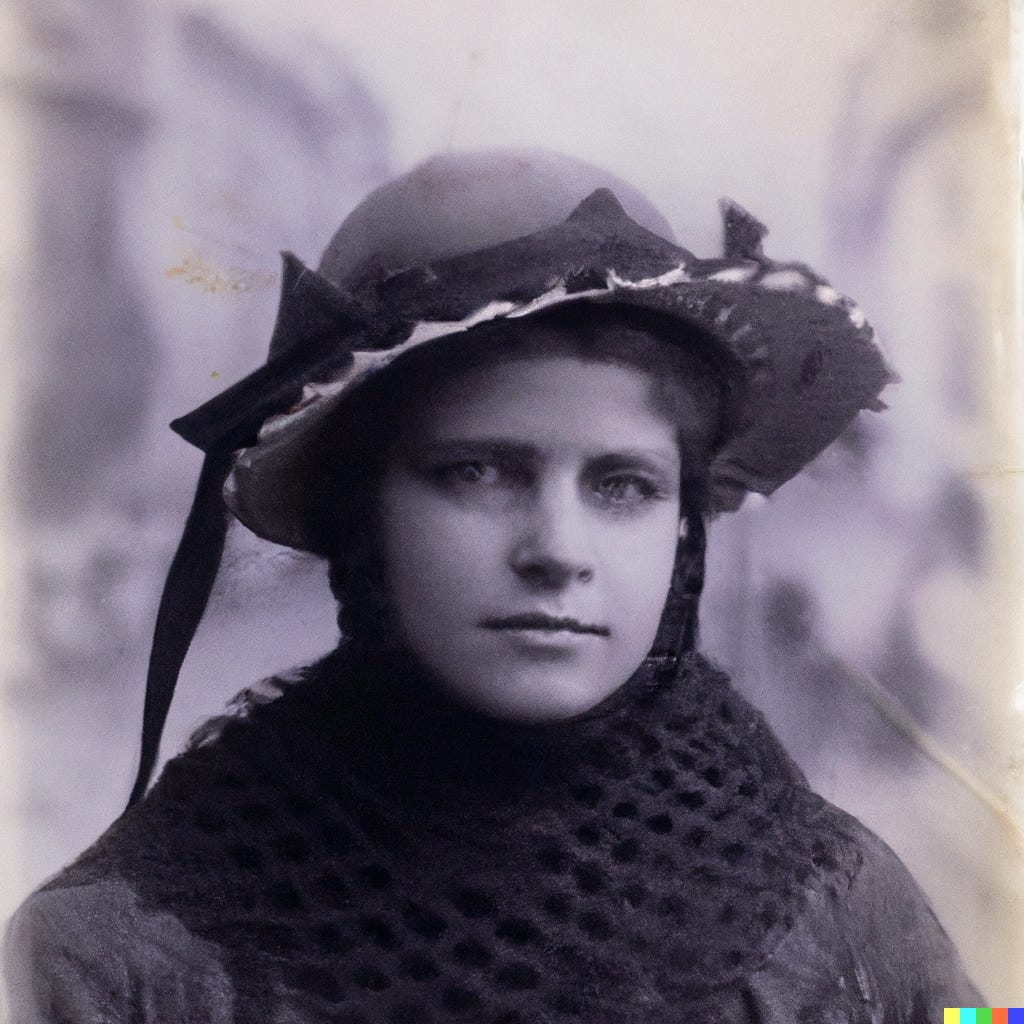
    Not a photograph – Image generated by DALL-E 2 A.I.

    The article on Cavalli’s images did mention the role that the photograph plays as a document. Up until the last few years, every photographic image that existed was, on a basic level, an image of someone or something that existed. If you saw a Victorian portrait photograph, you knew that at one time that person was alive.

    A.I. generated images such as those by Cavalli disrupt this. It is not a painting, or even a photo-realistic painting, but it is using the tropes and styles of Victorian photography to construct images that have these particular aesthetic qualities: The sharp subject, deep out of focus background, specific B&W toning, vignetting in the corners. Our visual culture tells us what a Victorian photograph should look like. Without the knowledge that these are in effect ‘digital art’, these images could be interpreted as actual Victorian images of people who existed, which is where I believe the problem with A.I. generated images can lie.

    Photographic history is littered with images that have been altered or manipulated to fit a particular discourse. From Abraham Lincoln’s head on John Calhoun’s body, to Stalin’s erasing of people who fell out of favour. However, these photos are well known, and the people existed – even if Stalin’s regime thought otherwise. The images may have been altered, but there is a narrative, a discourse that existed before the image was taken, and after it with the photograph entering the public sphere as a document. With A.I. generated images, there is no before narrative. Unless we know it is an A.I. generated image, what has gone before does not exist except in what the image shows us – or what the A.I. has been told to show us. As a viewer, we then create our own, incorrect, interpretation based on this information.

    To illustrate this article, I used the free A.I. image software DALLE-2 to generate two images in the style of Victorian photographs. The results are quite believable but there are issues once the images are scrutinised closer. As A.I. technology improves and becomes more widespread, there could be situations where images are created to suit someone’s own narrative to which the generated image is now a ‘proof’, a false document that could then enter contemporary discourse. This has already started to trickle onto social media, with a few examples of people generating images with A.I. in order create false narratives. This has mostly been harmless with the author eventually coming clean to say the images were A.I. generated, but the potential use of this technology to document or evidence events that did not happen is terrifying.

    Currently there are filters on A.I. image generators that will stop damaging images being created in the first place, but this wouldn’t stop innocently generated images being mistaken for people who’d once lived. It is up to the creator to do as much as they can to make people aware that the images are A.I., in a hope that the context around them comes from the fact they are generated by a computer. On a more positive note, it is conceivable that there could be competitions for A.I. generated images in much the same way they exist in the digital art world. Maybe Victorian-style generated images could be a category?

    While a lot of the current talk around A.I. appears to be quite negative, I do feel that the underlying technology should be praised and marvelled. A.I. could help with medical breakthroughs and in that regard, it should be pursued. In our photographic world, A.I. is already here in the form of clever software, but as far as image generation goes there is still a lot to discover as well as control.

    I personally feel this is exciting, but it is up to us as users and consumers to decide how this technology is used, and how far, morally, it should go. For photographers, artists and creators using A.I. software to generate or enhance our images, being open and honest about what has been achieved allows it to be contextualised on its own merits, within its own discourse.


    Baudrillard, J., (1994) Simulacra and Simulation, University of Michigan Press, Michigan

    Growcoot, M., (2020) petapixel.com, Victorian-Era People Who Never Existed: These Portraits Were AI-Generated [online], Available from: https://petapixel.com/2022/12/01/victorian-era-people-who-never-existed-these-portraits-were-ai-generated/

    Magritte, R., (1929) The Treachery of Images (This is Not a Pipe), Los Angeles County Museum of Art

  • Appreciating the Camera

    Appreciating the Camera

    Can digital cameras be appreciated alongside film cameras as the tools they are, or does nostalgia and aesthetic value always mean film cameras are appreciated more?

    In October 2021 I sold my Nikon D700, a camera I had desperately wanted ever since it was first released. I bought mine second-hand from my local camera shop and proceeded to photograph many weddings, portraits, landscapes and mountain bike sessions with it. However, as time and technology marches on, the DSLR form factor and mass of lenses and flashes became too unwieldy for my dodgy back and my self-consciousness. Looking for a smaller, lighter camera with no compromised on image quality I bought into Fuji, starting with the XE-1, and later the X-Pro2. As I drifted away from sports photography to a documentary-based practice, the XPro-2 more than superseded the XE-1, which I thought was a good match for the D700 for what I needed in a camera. I didn’t take a single shot with the Nikon for at least four, maybe five years. In all that time it sat in my ‘other’ camera bag with my D200 and a plethora of lenses doing nothing, but I couldn’t ever bring myself to sell it.

    Unfortunately, I come from a family that likes to hold on to things. Not quite up to hoarder level, but more acquiring things that only get thrown out once they’re worn out or beyond repair, never sold. For my own camera collection this means holding on items that work, of little value, that never get sold. Even taking old clothes to the charity shop takes a good month of soul-searching. There are some things that do hold sentimental value; My father’s Contax 139 and Mamiya 456 cameras are two examples. But I continue to use the Mamiya on an infrequent basis, actually making it my second most used camera, and more used than the D700 had been in the last five or so years.

    I can’t explain why I want to hold on to my old cameras – especially the ‘soulless’ digital ones that I saved up for and bought new with my hard-earned. I have a very well-used and beaten D100 – my first DSLR, that I converted to shoot Infra-Red. A D50, my father’s DSLR, and the aforementioned D200 that’s held together with Duck Tape. For some reason I’m keeping them despite having no plans to use them. Coming from a ‘use it until it wears out’ mantra, I could never sell them at the time of their replacements, as I never really found the need to upgrade cameras on a regular basis. Nowadays, their condition alone would mean that they are destined for the junk, not to mention a phone camera today would produce a better-quality image. They are worthless, but I hold on to them ‘just in case’. I’m at a loss to justify the scenario where I’d need to use a 6mp DSLR that shows noise above ISO400, but if the need arises, I guess I’m covered.

    This is the mindset I had to overcome selling the D700. While that camera was considered a flagship camera in its time, the 35mm equivalent sensor, (usable) high-ISO capability, and fast autofocus made it a ‘must have’. But at the end of the day it was only a tool. A tool that was replaced many years ago and is no longer required. It was also probably the only camera (apart from my F5) that was worth the postage selling it. I envy folks who can buy a camera, use it, then sell or part-exchange it a year or 18 months later with little depreciation.

    My collection of film cameras that I’ve picked up from antique and charity shops, inherited, or been given probably totals less than I sold the D700 for, but these cameras have something that the DSLR’s don’t have. I can’t quite place my finger on it, but they have a certain quality that is missing with the DSLR’s. They are mechanical film cameras. Some of them the epitome of the basic camera – a light-tight box with a lens at the front, film held in the rear and a shutter in the middle. My small collection ranges from cameras from the 1930’s through to the 1990’s, plus the Nikon F5. Nearly all of them work, and half of them I have taken nice photos with.

    Appreciating the Camera. Can we give digital cameras the same aesthetic value we do to film cameras?
    Images taken on my trusty XE-1

    Aesthetic Values

    Personally, these old film cameras have an aesthetic value that is greater than their monetary value. Displaying them can place them into the realms of an objet d’art in much the same way that museums display tools and artefacts from past cultures that had a specific function, but are now considered an object to admire (a gross simplification as a unit on my MA that covered this very subject dealt with, but that’s for another blog post). Displayed as a collection these cameras can be appreciated on their own terms; As individual mechanical statuettes showcasing the progression of ways to create a photographic record. Who used them? What photos did they take? Lost questions with no answers.

    As the DSLR form factor developed – basically a small computer mounted on the back of an SLR camera, mirror box proudly displaying a white logo on an all-black body – a certain romanticism as to what the camera could do and what it represented in the hands of a skilled photographer was lost.

    That’s not to assume that DSLR cameras, or even the mirrorless cameras that have been taking a larger bite out of their market share can’t produce era-defining images. I’m arguing that the camera, the tool itself, can have a particular ‘aura’, to hijack Walter Benjamin’s term. Ironically this  was coined to discuss the very means of mechanical production that was seen to be de-valuing art that his 1935 essay discussed. However, it appears that this ‘aura’ has waned with the advent of the digital camera.

    In the past these cameras really were dark boxes that required an intimate knowledge of light and shadow, rather than today’s intimate knowledge of Lightroom and Capture 1. Fifty years from now I wonder if camera collectors would be placing on their shelves Nikon D100’s or Canon 10D’s in the same way we place Voigtlander, Agfa, and Comet? Or will the ever-evolving consumerist photographic machine mean that digital cameras have a fixed life-cycle of part-exchange for a new model, or thrown away (and hopefully recycled as much as possible). As such they will have no value, monetarily, aesthetically, or sentimentally past a certain point and we’ll still hold on to the distant past of what will be century-old mechanical cameras from East Germany or Japan.

    In the same way a mechanical watch has more perceived aesthetic value over a digital watch, so it seems that mechanical cameras will always stand the test of time for their aesthetic value. As I’ve written about before, vinyl records are enjoying a resurgence, and small companies are producing new film stock (albeit at a price). Maybe we shall see in the next five years a new manual camera being released from a small start-up company?* To many photographers, the act of taking a picture is also the act of preserving memory. A memento-mori that will outlive us and that can be passed down the generations. I’d like to think that it’s not just the images that can do this, but also the tools that were used to capture these memories. Maybe we can start to appreciate the camera, film or digital, as a tool and value it for what it can do.

    *I do realise that in the large-format film world there are new manual cameras being released all the time – I am hypothesising a new camera in the 35mm world, which some would say is running on life-support, and others that it’s now just a niche form of artistic expression.


    Post Script

    I generally write things as they enter my head, then take a long time editing and polishing the final article. A new baby has that effect. Since originally writing this in January 2022, I left my (uninsured) X-Pro2 with 27mm lens in a pub. After a month of not realising I’d left it there I contacted the pub, but no-one had handed it in. A year on I’m still a bit raw about it. I pretty much stopped taking photos for most of 2022 because of what had happened (even the birth of my son in the summer has been documented sporadically with my phone), but I’m slowly getting back into it with the trusty XE-1. Ironically, the D700 would have been a useful stand-in…


    Further Reading

    Film Photography is not dead

    Digital Nostalgia – 5 Early Digital Cameras from between 2001 and 2005 – From 35mmc.com

  • How is Pose used in Portrait Photography?

    How is Pose used in Portrait Photography?

    To finish my Master’s Degree I chose to write a dissertation (as opposed to a Final Major Project). This was initially daunting as the limit was 20,000 words (excluding quotes), but good guidance and planning meant this was filled relatively easily. I chose to write about portrait photography as this was one area that I, despite not being a portrait photographer, have always found fascinating from both an art-historical and theoretical photography point of view. Portrait photography is a very large subject to look at so I decided to concentrate on pose, and how pose is used in photographic portraits.

    This was expanded to discuss how pose can form a representation of the subject and problems that can arise though manipulation of the pose. This could be intentionally from the photographer, or unintentionally from the reading of the pose by the viewer, based on their cultural, geographical, or social background. Furthermore, how pose and the use of pose has developed and changed over time in response to art history and wider visual culture.

    To underpin my dissertation, I used philosopher Jacques Derrida’s concept of Parergon, using the pose as a device to frame the subject, which I took further and developed within the theorist Roland Barthes’ ideas of Studium and Punctum.

    My dissertation began by discussing Victorian photography and how pose could relate to class and status, before using content analysis on online archives of photographs by Isle of Wight Photographers. I am a Volunteer at Carisbrooke Castle Museum on the Island, where I work in the archive researching and adding accessions, with a specific interest in Victorian and Edwardian photography. I had hoped to conduct my analysis there but as Covid-19 prevented this, I used the Castle’s online archive supplemented by my own Victorian portrait photography collection and the Royal Collections online archive. The findings of my analysis aligned with contemporary ideas on pose, showing that certain ideas around pose and how pose is used in relation to representation in portrait photography may have formed much earlier in art history.

    I further developed my argument to look at fashion photography in the 1950’s, discussing gender stereotypes that had formed in Victorian photography. Using theories by sociologist Erving Goffman I looked at the move away from using pose to advertise a product to an aspirational lifestyle, and how the use of pose was developed to reflect more on real life, becoming an important part of visual culture. I considered the influence of wider post-War visual culture in the form of recruitment posters and Hollywood Glamour. For my case study I discussed photographs by Richard Avedon and used semiotic analysis to read deeper into the images.

    Looking at contemporary photography, I used portraits by Reinke Dijkstra as my case study, and discussed psychoanalyst Jacques Lacan’s Gaze theory and how it was developed though Laura Mulvey’s application of Gaze in film theory. I continued to reinforce the idea that wider visual culture is a catalyst to the continued development of the pose in photography. To continue with contemporary portrait photography, I looked at social media, and how pose is used to represent the self, introducing digital cultures and discussing how people subconsciously choose to pose in a certain way. To back up my research I conducted online interviews with two portrait photographers, Clare Hewitt and Jason Alden, to see how they approach pose and its influence on the representation of their subjects.

    Lastly, I looked at my own family photographs and how they could form a representation of myself. I considered author and academic Marianne Hirsch’s idea of post-memory, using family photographs to create memories of family members that we’d never met, except though how we see and read their pose though photographs.

    As always, looking back on it there are a lot of avenues I could have taken and concentrated on, and if I were to re-write it I would exclude some parts and go into a lot more detail. I’m especially wanting to re-visit the idea of Parergon in relation to Barthe’s Studium and Punctum.

    20,000 words is a lot to post in one go, so please download my dissertation if you’re interested in reading it.

    As a post-script, I submitted my dissertation for a research distinction from the Royal Photographic Society, which was approved in May 2021, giving me the distinction of Associate of the Royal Photographic Society.


  • Digital Technology, Landscape Photography & Postdigital

    Digital Technology, Landscape Photography & Postdigital

    This essay was the first assignment on our MA and formed the conclusion to our unit on Material, Digital and Convergent Cultures. While I’m overall happy with the essay, I got 74% for it, reading it now there are a lot of things that could have been expanded upon, and areas gone into more detail. Landscape photography theory is one area that I’d like to research in more depth, and this essay is a good starting point. It is presented as it was handed in.

    This essay will discuss the material, digital and convergent cultures of creative production in relation to landscape photography. To do this I will use two examples of landscape images by artists Dan Holdsworth and David Thomas Smith who use post-photography, where photographic images have been created without a camera, using readily available digital data to construct their images. I will consider the technology used and if the resultant images challenge perceptions and raise awareness of the environmental and ecological impact of humans in comparison to material landscape photography.

    I will use my own positionality as an environmental landscape photographer, and those views by practitioners, critics and theorists of photography and convergent cultures such as Robert Shore, Anders Fagerjord, Anna Munster and Henry Jenkins. I will critique what impact the digital technologies of creative production have on the traditional notion of landscape photography, and what questions arise from considering landscape photography in post-photographic terms. I will also question the idea of convergence to see if there are any suitable alternatives that can be used within a Postdigital world.

    Convergence

    Digital technology has already converged with photography, making it quicker and easier for anyone to produce and display their photos. Digital photography is now so engrained in our culture that I would class this as traditional photography: where people are actively taking and sharing photographs to document and record the world around them. Post-photography is where the image already exists, either as a digital or material image, and is used to create new artworks from found imagery. As art editor Robert Shore states: ‘Given the abundance of pre-existing visual material in our hyper-documented world, it’s unsurprising that an increasing amount of photographic art begins with someone else’s pictures’ (Shore 2014). The digital photographic convergence occurred during the 1990’s, alongside other consumer technologies converging with the internet and material forms of media in an age of digitisation. This convergence of technologies with an interconnected digital world and our reliance on it to conduct our everyday lives has humanised digital technology, leading us into the Postdigital, which Mel Alexenberg defines as:

    ‘pertaining to art forms that address the humanization of digital technologies through interplay between digital, biological, cultural, and spiritual systems, […] and artworks created with alternative media through participation, interaction, and collaboration in which the role of the artist is redefined. (Alexenberg 2011).

    As Anders Fagerjord argues, ‘convergence is over. The media have already converged.’ (Fagerjord 2009). Fagerjord suggests that in our Postdigital age it is not convergence we experience, but remix culture:

    ‘[…] remix is what comes after convergence. […] Digital representation has become a lingua franca; it has created a shared space where forms from different genres in different media may be combined in new ways, creating new genres’ (ibid).

    As Alexenberg suggests, the role of the artist has become redefined and has moved from presenting works created from traditional or converging media, to a remix of already converged media in the Postdigital world. Within photography, this proliferation of digitisation which includes that of the material image for preservation and archive, has given rise to large repositories of data, most of which is freely available over the internet. It is through these repositories, be they photo sharing sites or public archives, that artists find and remix – to use Fagerjord’s term – this data to produce new forms of image production, giving rise to post-photography.

    ‘This “found” internet content serves as a vast laboratory for major experimentation, underpinning the concept of post-photography, with endless possibilities for artists to recreate original works using avant-garde techniques drawn from both the digital and analogue eras’ (Martin, 2017).

    These endless possibilities within landscape photography enable artists to work with a much broader range of source material than just a natural landscape, creating images that are received as photographs and artworks in much the same way as contemporary traditional landscape photography. Post-photography allows greater freedom of expression, allowing the artist to not be limited by location or time, producing works that are not possible with traditional photographic techniques. These new data-driven works, while still relying on a landscape photography aesthetic, that is having the underlying representation and codes in line with traditional landscape photography, could be termed post-landscape photography. This means artists can explore new ways of showing a landscape with digital data and use this data to raise awareness of the human impact on the natural environment. As academics Justin Clemens and Adam Nash argue, ‘Data is absolutely not a phenomenological thing. It cannot be experienced as such, […] however, we can manipulate data with ease; in fact, it is integrally available as manipulable’ (Nash & Clemens 2010). It is only with this manipulation of the data through artistic expression that a remix can be produced to create new forms of creative production, and new ways of seeing or representing a landscape in a Postdigital context.

    Dan Holdsworth

    Dan Holdsworth’s work Transmission: New Remote Earth Views (2012) uses data taken from USGS topographical laser scans which are usually used to measure changes in the land and climate. From this data, Holdsworth produces crisp, stark images that are devoid of life, giving a scientific view of his chosen landscapes.

    ‘Stripped of surface detail there are no signifiers of a natural wilderness or picturesque aesthetic, no invoking of the Romantic Sublime; and yet at the same time what is antithetical to these visual tropes – the man-made, the artificial, the vernacular of the New Topographics photographers – is also absent’ (Lewis n.d).

    What we are being presented with is a rendered image, a simulation of a real, recognisable landscape, but not a photograph of one. As Jean Baudrillard writes ‘Simulation […] is the generation by models of a real without origin or reality: a hyperreal’ (Baudrillard 2001). This theory of simulation is illustrated by Holdsworth in the form of scientific data displayed with the aesthetics of landscape photography. However, I would argue that this isn’t convergence as Henry Jenkins suggests: ‘Where old and new media collide, where grassroots and corporate media intersect, where the power of the media producer and the power of the media consumer interact in unpredictable ways’ (Jenkins 2008).  Holdsworth’s work is ‘new media’, but there is no old media to converge with. It’s digital technology mixing with digital data. Applied to the following example, Jenkins’ theory seems outdated, but remix could apply as it’s taking different media forms and creating new genres. In this instance, it is an example of post-landscape photography, combining the aesthetic of landscape photography with that of scientific datasets, producing a hyperreal simulation of the real world in order to realise the artist’s intent, one that couldn’t be achieved through material photography.

    Figure 1: Holdsworth 2012

    This data-driven simulated image allows Holdsworth to position the viewpoint from any angle in his simulated world. In Yosemite: C6 (figure 1) Holdsworth has mirrored the viewpoint of Ansel Adams’ Half Dome, Cottonwood Trees (figure 2). With the unlimited viewpoints that a digital rendering can offer, it’s interesting that Holdsworth has used a similar view to Adams’, who was famous for his Romantic views of Yosemite. It may be that because of the unlimited views available it’s easier to keep to a persistent visual language, choosing views that are closer to what we would experience as a viewer within the environment in order to be less incongruous.

    Figure 2: Adams 1932

    The nature of Holdsworth’s images mean that they are devoid of any markers such as trees or natural elements to give an idea of scale or perspective such as atmosphere, creating a distorted image that is initially hard to figure out. This has the effect of creating an other-worldly view, similar to images sent back from the moon or asteroids, but of a familiar place that we recognise from traditional landscape images. This distortion causes the viewer to consider why the work has been presented this way, rather than from a more familiar view such as Adams’.

    As critic Emma Lewis writes, ‘Holdsworth is working outside of the wilderness myths that render the photographic avant-garde the ‘after’ to Watkins and Ansel Adams’ ‘before’. (Lewis n.d.) This in some respect highlights the use of post-photography, or post-landscape photography, to work outside of conventional displays of a familiar landscape and reveal to us versions of them that we are unable to see in reality, presenting a critical, scientific view, free from romanticism. Tim Ingold suggests that landscape is, ‘not a picture in the imagination […] nor an alien and formless substrate awaiting the imposition of the human order’ (Ingold 1993). I would argue that the Postdigital has allowed us to visually construct imaginary landscapes, and that Holdsworth’s images have a stronger visual impact due to the lack of natural elements, questioning how we interpret and understand such images.

    David Thomas Smith

    David Thomas Smith’s project, Anthropocene, uses data taken from satellite photos on Google Maps of locations that have globally significant ‘social, economic or political importance in the world’ (Smith in Shore 2014). The term Anthropocene is recent term coined to define the next geological epoch as one that has been altered through human impact on the earth (Stromberg 2013) and Smith’s images reflect this in his choice of locations.

    ‘Anthropocene itself reflects upon the complex structures that make up the centres of global capitalism, transforming the aerial landscapes of sites associated with industries such as oil, precious metals, consumer culture, information and excess’ (Smith, 2013).

    To create his images, Smith combined thousands of screenshots from Google to create a high-resolution image, which is then mirrored horizontally and vertically to create a pattern that is similar in style to those of Persian carpets. Smith’s other inspiration was Afghan War rugs made during the 1980’s Soviet occupation, where Afghani women would document the volatile culture, creating ‘objects that contained and recorded a particular history’ (Smith in Shore 2014). Smith makes an interesting comparison to Persian and Afghan rugs, aulthough I wouldn’t immediately make the connection. I feel Three Gorges Dam (figure 3) and Beijing Airport (figure 4) are the closet to the aesthetic of a Persian rug, especially the sinuous nature of the road system and natural forms. The process of creating the images from thousands of small screen shots to manually create a larger image, 1.8m x 1.2m, is similar to the rug weavers using individual threads to construct a rug and makes the work more labour intensive than its digital nature would otherwise suggest. Smith classes his work as documentary photography. In my opinion, I consider the work also landscape photography, as it’s presenting a narrative of human impact in the landscape, but in a more aesthetically pleasing way than more hard-line documentary photography.

    Figure 3: Smith 2010

    Figure 4: Smith 2010

    Comparing Smith’s Three Gorges Dam (figure 3) with Nadav Kander’s Three Gorges Dam VI Yichang, Hubei Province, (figure 5) it is easy to see the main benefit of the satellite image. It shows a huge area of land giving the viewer a sense of scale that would be impossible with traditional photography. This ‘God’s Eye View’ (Sturken and Cartwright 2009) gives a detached, remote viewpoint, but one that is also very contemporary and familiar to a Postdigital society;

    ‘[Satellite] images are part of the history of modernity and visuality, in which an early fascination with photography was organized around a fascination with technologies for seeing things too small, too far away, or to hidden for the unaided human eye to see’ (ibid).

    Kander’s image, while also a photograph of the Three Gorges Dam, is a lot more humanistic. Like Ansel Adams picture of Yosemite, the image conforms to our own ideas of how a picture of a landscape should look, and the inclusion of the people sat on the rock embankment makes the viewer feel more connected. Both images show the impact this hydroelectric project has had on the environment, but with Kander, we are reminded how this has impacted on the human population.

    Figure 5: Kander 2007

    While Donna Haraway is critical of the term Anthropocene, which ‘obtained purchase in popular and scientific discourse in the context of ubiquitous urgent efforts to find ways of talking about, theorizing, modelling, and managing a Big Thing called Globalization’ (Haraway 2016), I feel that Smith’s project does highlight the human impact on the earth, and how humans have manipulated the natural environment for their own benefit in a global context. I would argue Smiths images do represent an understanding the Anthropocene, even if his use doesn’t quite fit into contemporary academic thinking. These images are closer to traditional photography than Holdsworth’s computer generated images, and as such could be better received by a wider audience looking at them from an aesthetic point of view. I would also say that they’re not an example of convergence in Jenkins’ sense as digital photography, satellite images and the distribution of them have already converged, but I do see it as a remix as it’s using appropriated images in a way that is mixing post-photography with a material aesthetic from the materiality of Afghan and Persian rugs.

    Digital Technologies

    The digital technologies that Holdsworth and Smith used to create their images have only existed for a short time. In Smith’s case, the freely available satellite images that can be appropriated and remixed, allow artists to explore issues such as the human impact on the environment or privacy. Satellite images allow the artist to capture views from the Middle East, Siberia, or China, without having to visit them. While this apparent democratisation of data could be the underlying foundation of post-convergent or remix culture, the data still has to be collected and distributed.

    Google is a global technology giant with the resources to map the world, but this brings up important questions on the display and use of this data. However, government-level censorship may exist as Google could be obliged to manipulate sensitive areas from county to country. Maps are a powerful political tool created by governments to control their borders. Satellite photography is now available to nearly everyone with an internet connection, undermining the politics of borders and governments, except those under strict state control such as China, where private surveying and mapping is illegal.

    Google watermark their satellite images to protect their IP, and this could be considered a form of ownership of the world, or at least the simulated world that exists in Google Maps. If Google own the images, then work produced from these images could be termed appropriation, such as Marcel Duchamp’s L.H.O.O.Q (1919) or Sherrie Levine’s series After Walker Evans (1981). Appropriation is one key aspect to post-photography but also calls into question the notion of author and copyright: who owns the rights to the work. The appropriation of digital data and the remix of it into new forms of artwork shifts power relations away from media producers such as Google, or the original content creators, towards those of the artist as the disseminator of this information, albeit curated. This changes the point of reception from those using satellite data for its intended purpose, to a new audience in the form of a material artwork that people experience.

    Appropriation is nothing new in art, and remix could be considered appropriation for the postdigital era. ‘Remix provides for new and interesting forms of artistry, challenges the established hierarchies of the culture industry, and demonstrates the way that creativity has always depended upon and borrowed from others’ (Gunkle 2018). Despite this appropriation, which Smith has noted that Google are aware of, it is still large corporations that have ultimate control over what data is released and is allowed (or appropriated) to be used. ‘Corporations – and even individuals within corporate media – still exert greater power than any individual consumer or even the aggregate of consumers’ (Jenkins 2006). In our age of litigation, one would need to be very careful of appropriation or remix, as large corporations control their own IP and copyright of the data.

    The Postdigital world has its foundations in the convergence of material and digital cultures. For example, the mobile phone converging with both video camera and computer which can be used to both record one’s thoughts and ideas, as well as broadcast or publish them through dedicated media outlets such as YouTube, Flickr, or Facebook. This allows anyone with an internet connection to take the data from one person or agency and remix this into a new form of artistic production.

    ‘Digital data may be copied without loss of quality, so it has become much easier for anyone to remix, recombine, and create new dependent works. […]. And as the digital network reaches anyone, the power relations have also been remixed, allowing anyone to be a creator, publisher, or broadcaster—or prod-user’ (Fagerjord 2009).

    This remixed data can then be uploaded, allowing artists to create their own platforms for sharing their work, free from galleries and curators. This unmoderated and un-curated art world could be an artistic free-for-all, with no authoritative voice to moderate what is put up. However, this practice becomes self-moderating, with people choosing what they want to look at with well-produced artworks becoming well-known or ‘viral’, allowing audiences all over the world to experience them. While everyone can be a creator or publisher, everyone is also now a curator and critic.

    Post-Convergence

    Post-convergence can consider the past convergence of media technologies as Jenkins proposed, alongside digitisation and remix culture in line with Fagerjord’s theory. It can also explain the divergence that has come about from Jenkins’ theory of convergence within our postdigital world. As Fagerjord states;

    ‘The concept of convergence is stretched beyond what is meaningful […] rather than converging into fewer technologies, companies, or genres, we are witnessing a proliferation of media; a divergence […] the consequences of digitalization’ (Fagerjord 2009).

    The evidence for this, Fagerjord argues, is that there are more genres of media around, and more being created than a convergent model would dictate. For example, post-landscape photography being a remix of traditional landscape photography, or its aesthetics, and post-photography, but creating a divergence away from traditional photography. To counter this, academic Anna Munster proposes a duality where both convergence and divergence can both apply;

    ‘We need to remind ourselves that the differential unfolding of new media — played out in this field of immersive and computer-mediated environments through the relations between the virtual propensities of information and the actualizations of information in concrete social-technical assemblages — can tend toward both convergence and divergence (Munster 2006).

    I would argue that we are experiencing post-landscape photography through post-convergence. Taking into consideration the digitised nature of production, including areas such as computer science, 3D modelling, the creation of simulated worlds, and remixing these digital technologies to create new forms of landscape images. As Clemens and Nash propose; ‘It is only with post-convergence that we realise that we are no longer – and therefore never have been – subject to predetermined parameters in art’ (Nash & Clemens 2010). Both Holdsworth and Smith are using digital technologies that that move on from Jenkin’s ideas of convergence. Using not only digital technology such as Google Maps, but scientific data such as laser scans and combing them with aesthetics that are tied to our current visual understanding of landscape photography.

    Conclusion

    Geographers Stephen Daniels and Denis Cosgrove wrote; ‘A landscape is a cultural image, a pictorial way of representing, structuring, or symbolising surroundings’ (Daniels and Cosgrove 1988). Landscape photography is the act of representing these surroundings through a literal photographic representation. The traditional photographic way of producing a landscape image will always have its place, certainly to depict an aesthetic and romantic point of view. But thinking of landscape photography in post-photographic terms, has to take into account post-convergence and remix. These terms are still quite new in photography discourse and have not had a chance to critically mature. Landscape photography has a long history in showing our natural environment and more recently how humans have encroached and changed it. By using digital technologies through post-photography to show landscapes, we are more able to re-structure our view of them within the Postdigital world, offering new perspectives, both literally in the form of satellite views and through the interpretation of scientific data such as Dan Holdsworth’s images.

    How landscape photography moves forward within post-photography and post-convergence depends on the artists ideas and technologies available, but these are constantly changing. The digital data used calls into question ownership and appropriation, but while there is precedent for appropriation in art, artists do tread a fine line. If the technology is available, then should this be viewed as a data free-for-all? If too many people start to use this, then this data could become monetized, making the idea of post-landscape photography only available to those who can afford it. Landscape photography has always been a genre that can bring aesthetic pleasure to many, but it also raises important questions on ecology and the environment in an ever more globalised world.

    In order to be relevant, landscape photographers and artists need to embrace a transdisciplinary approach to technology and search out new ways of highlighting contemporary issues, using data that illustrates more than can be seen with our own eyes. ‘Photography is above all else a medium of witness, a self-effacing window onto the world which is primarily concerned with recording that thing to which we breezily refer as ‘reality’’ (Shore 2014). This notion of reality depends greatly on the artist and what they are presenting to us as a ‘reality’. There are many realities and many issues. One single reality isn’t enough. Landscapes seen through post-photography allow construction of new realities, those that we are unable to experience, but that we need to know about in order understand our material world. As Anna Munster states:

    ‘It will be up to artists, designers, technicians and new media activists of all shapes and sizes to create these with an eye for not simply new perceptual experiences but the production of new forms of social, political and ethical relationships’ (Munster 2006).

    As post-photography is new, its future use within the genre of landscape photography can only be suggested at by what has gone before. Some may argue that it can’t be classed as photography, certainly not in the traditional sense, but through remix the genres will overlap and quite often the result is a material photographic image. But post-photography may be the outlet that allows creative landscape practitioners, rather than landscape photographers, to create works of political and ecological importance though remixing digital technologies that have yet to be realised. I personally think that to highlight global problems in the future, post-landscape photography will move further away from traditional photography into the realms of Augmented Reality. This will allow individuals to experience, rather than view, landscapes using data remixed from many different disciplines and technologies to construct simulations rather than images of landscapes. These may keep to the visual cues and signs that we are used to, although in a Postdigital culture even these may end up being remixed.


    Image References

    ADAMS, A., 1932. Half Dome, Cottonwood Trees [online] Available from http://www.museumsyndicate.com/item.php?item=34479 [accessed 18/11/2019]

    HOLDSWORTH, D., 2012. Yosemite: C6 [online] available from https://www.danholdsworth.com/works/transmission/yosemite/9/ [accessed 18/11/2019

    KANDER, N., 2007.Three Gorges Dam VI Yichang, Hubei Province [online] available from https://www.nadavkander.com/works-in-series/yangtze-the-long-river/single#42 [accessed 19/11/2019]

    SMITH, D. T., 2010. Three Gorges Dam [online] available from https://www.david-thomas-smith.com/anthropocene [accessed 18/11/2019]

    SMITH, D. T, 2010. Beijing Airport [online] https://www.david-thomas-smith.com/anthropocene [accessed 18/11/2019]

    Bibliography

    ALEXENBERG, M., 2011. The Future of Art in a Postdigital Age: From Hellenistic to Hebraic Consciousness. Bristol: Intellect Books Ltd

    COSGROVE, D., & S. DANIELS, 1988. The Iconography of Landscape. Cambridge: Cambridge University Press

    FAGERJORD, A., 2010. After Convergence: Youtube and Remix Culture. in J. HUNSINGER et al, International Handbook of Internet Research. Netherlands: Springer

    GUNKEL, D.J., 2018. Remixology: An Axiology for the 21st Century and Beyond. Found Footage Magazine, (4), pp. 52-59.

    HARAWAY, D., 2016. Tentacular Thinking: Anthropocene, Capitalocene, Chthulucene. e-flux journal. 75

    INGOLD, T., 1993. The Temporality of the Landscape. World Archaeology, 25(2), 152-174

    JENKINS, H., 2008. Convergence Culture: Were Old and New Media Collide. New York: New York University Press

    LEWIS, E., nd. Transmission: New Remote Earth Views. Dan Holdsworth [online] available from: https://www.danholdsworth.com/texts/transmissionnewremoteearthviews/ [accessed 18/11/2019]

    MARTIN, F., 2017. Post-Photography: The Artist with a Camera. Aesthetica Magazine [online] available from: https://www.aestheticamagazine.com/post-photography/ [accessed 23/11/2019]

    MUNSTER, A., 2006. Materializing New Media: Embodiment in Information Aesthetics. Dartmouth: University Press of New England

    NASH, A., and J. CLEMENS, 2010. Seven Theses on the Concept of ‘Post-Convergence’ [online] available from https://www.academia.edu/27057333/Seven_theses_on_the_concept_of_post-convergence [accessed 26/11/2012]

    SHORE, R., 2014. Post-photography: The Artist with a Camera. London: Laurence King Publishing

    SMITH, D. T., 2013. Anthropocene. [online] available from: https://www.thecopperhousegallery.com/usr/library/documents/main/anthropocene-works.pdf [accessed 23/11/2012]

    STROMBERG, J., 2013. What Is the Anthropocene and Are We in It? [online] available from: https://www.smithsonianmag.com/science-nature/what-is-the-anthropocene-and-are-we-in-it-164801414/ [accessed 27/11/2019]

    STURKEN, M. and L. CARTWRIGHT, 2009. Practices of Looking: An Introduction to Visual Culture. 2nd ed. New York: Oxford University Press