Tag: Digital

  • Appreciating the Camera

    Appreciating the Camera

    Can digital cameras be appreciated alongside film cameras as the tools they are, or does nostalgia and aesthetic value always mean film cameras are appreciated more?

    In October 2021 I sold my Nikon D700, a camera I had desperately wanted ever since it was first released. I bought mine second-hand from my local camera shop and proceeded to photograph many weddings, portraits, landscapes and mountain bike sessions with it. However, as time and technology marches on, the DSLR form factor and mass of lenses and flashes became too unwieldy for my dodgy back and my self-consciousness. Looking for a smaller, lighter camera with no compromised on image quality I bought into Fuji, starting with the XE-1, and later the X-Pro2. As I drifted away from sports photography to a documentary-based practice, the XPro-2 more than superseded the XE-1, which I thought was a good match for the D700 for what I needed in a camera. I didn’t take a single shot with the Nikon for at least four, maybe five years. In all that time it sat in my ‘other’ camera bag with my D200 and a plethora of lenses doing nothing, but I couldn’t ever bring myself to sell it.
    Unfortunately, I come from a family that likes to hold on to things. Not quite up to hoarder level, but more acquiring things that only get thrown out once they’re worn out or beyond repair, never sold. For my own camera collection this means holding on items that work, of little value, that never get sold. Even taking old clothes to the charity shop takes a good month of soul-searching. There are some things that do hold sentimental value; My father’s Contax 139 and Mamiya 456 cameras are two examples. But I continue to use the Mamiya on an infrequent basis, actually making it my second most used camera, and more used than the D700 had been in the last five or so years.

    I can’t explain why I want to hold on to my old cameras – especially the ‘soulless’ digital ones that I saved up for and bought new with my hard-earned. I have a very well-used and beaten D100 – my first DSLR, that I converted to shoot Infra-Red. A D50, my father’s DSLR, and the aforementioned D200 that’s held together with Duck Tape. For some reason I’m keeping them despite having no plans to use them. Coming from a ‘use it until it wears out’ mantra, I could never sell them at the time of their replacements, as I never really found the need to upgrade cameras on a regular basis. Nowadays, their condition alone would mean that they are destined for the junk, not to mention a phone camera today would produce a better-quality image. They are worthless, but I hold on to them ‘just in case’. I’m at a loss to justify the scenario where I’d need to use a 6mp DSLR that shows noise above ISO400, but if the need arises, I guess I’m covered.

    This is the mindset I had to overcome selling the D700. While that camera was considered a flagship camera in its time, the 35mm equivalent sensor, (usable) high-ISO capability, and fast autofocus made it a ‘must have’. But at the end of the day it was only a tool. A tool that was replaced many years ago and is no longer required. It was also probably the only camera (apart from my F5) that was worth the postage selling it. I envy folks who can buy a camera, use it, then sell or part-exchange it a year or 18 months later with little depreciation.

    My collection of film cameras that I’ve picked up from antique and charity shops, inherited, or been given probably totals less than I sold the D700 for, but these cameras have something that the DSLR’s don’t have. I can’t quite place my finger on it, but they have a certain quality that is missing with the DSLR’s. They are mechanical film cameras. Some of them the epitome of the basic camera – a light-tight box with a lens at the front, film held in the rear and a shutter in the middle. My small collection ranges from cameras from the 1930’s through to the 1990’s, plus the Nikon F5. Nearly all of them work, and half of them I have taken nice photos with.

    Appreciating the Camera. Can we give digital cameras the same aesthetic value we do to film cameras?
    Images taken on my trusty XE-1

    Aesthetic Values

    Personally, these old film cameras have an aesthetic value that is greater than their monetary value. Displaying them can place them into the realms of an objet d’art in much the same way that museums display tools and artefacts from past cultures that had a specific function, but are now considered an object to admire (a gross simplification as a unit on my MA that covered this very subject dealt with, but that’s for another blog post). Displayed as a collection these cameras can be appreciated on their own terms; As individual mechanical statuettes showcasing the progression of ways to create a photographic record. Who used them? What photos did they take? Lost questions with no answers.

    As the DSLR form factor developed – basically a small computer mounted on the back of an SLR camera, mirror box proudly displaying a white logo on an all-black body – a certain romanticism as to what the camera could do and what it represented in the hands of a skilled photographer was lost.

    That’s not to assume that DSLR cameras, or even the mirrorless cameras that have been taking a larger bite out of their market share can’t produce era-defining images. I’m arguing that the camera, the tool itself, can have a particular ‘aura’, to hijack Walter Benjamin’s term. Ironically this  was coined to discuss the very means of mechanical production that was seen to be de-valuing art that his 1935 essay discussed. However, it appears that this ‘aura’ has waned with the advent of the digital camera.

    In the past these cameras really were dark boxes that required an intimate knowledge of light and shadow, rather than today’s intimate knowledge of Lightroom and Capture 1. Fifty years from now I wonder if camera collectors would be placing on their shelves Nikon D100’s or Canon 10D’s in the same way we place Voigtlander, Agfa, and Comet? Or will the ever-evolving consumerist photographic machine mean that digital cameras have a fixed life-cycle of part-exchange for a new model, or thrown away (and hopefully recycled as much as possible). As such they will have no value, monetarily, aesthetically, or sentimentally past a certain point and we’ll still hold on to the distant past of what will be century-old mechanical cameras from East Germany or Japan.

    In the same way a mechanical watch has more perceived aesthetic value over a digital watch, so it seems that mechanical cameras will always stand the test of time for their aesthetic value. As I’ve written about before, vinyl records are enjoying a resurgence, and small companies are producing new film stock (albeit at a price). Maybe we shall see in the next five years a new manual camera being released from a small start-up company?* To many photographers, the act of taking a picture is also the act of preserving memory. A memento-mori that will outlive us and that can be passed down the generations. I’d like to think that it’s not just the images that can do this, but also the tools that were used to capture these memories. Maybe we can start to appreciate the camera, film or digital, as a tool and value it for what it can do.

    *I do realise that in the large-format film world there are new manual cameras being released all the time – I am hypothesising a new camera in the 35mm world, which some would say is running on life-support, and others that it’s now just a niche form of artistic expression.


    Post Script

    I generally write things as they enter my head, then take a long time editing and polishing the final article. A new baby has that effect. Since originally writing this in January 2022, I left my (uninsured) X-Pro2 with 27mm lens in a pub. After a month of not realising I’d left it there I contacted the pub, but no-one had handed it in. A year on I’m still a bit raw about it. I pretty much stopped taking photos for most of 2022 because of what had happened (even the birth of my son in the summer has been documented sporadically with my phone), but I’m slowly getting back into it with the trusty XE-1. Ironically, the D700 would have been a useful stand-in…


    Further Reading

    Film Photography is not dead

    Digital Nostalgia – 5 Early Digital Cameras from between 2001 and 2005 – From 35mmc.com

  • Digital Technology, Landscape Photography & Postdigital

    Digital Technology, Landscape Photography & Postdigital

    This essay was the first assignment on our MA and formed the conclusion to our unit on Material, Digital and Convergent Cultures. While I’m overall happy with the essay, I got 74% for it, reading it now there are a lot of things that could have been expanded upon, and areas gone into more detail. Landscape photography theory is one area that I’d like to research in more depth, and this essay is a good starting point. It is presented as it was handed in.
    This essay will discuss the material, digital and convergent cultures of creative production in relation to landscape photography. To do this I will use two examples of landscape images by artists Dan Holdsworth and David Thomas Smith who use post-photography, where photographic images have been created without a camera, using readily available digital data to construct their images. I will consider the technology used and if the resultant images challenge perceptions and raise awareness of the environmental and ecological impact of humans in comparison to material landscape photography.

    I will use my own positionality as an environmental landscape photographer, and those views by practitioners, critics and theorists of photography and convergent cultures such as Robert Shore, Anders Fagerjord, Anna Munster and Henry Jenkins. I will critique what impact the digital technologies of creative production have on the traditional notion of landscape photography, and what questions arise from considering landscape photography in post-photographic terms. I will also question the idea of convergence to see if there are any suitable alternatives that can be used within a Postdigital world.

    Convergence

    Digital technology has already converged with photography, making it quicker and easier for anyone to produce and display their photos. Digital photography is now so engrained in our culture that I would class this as traditional photography: where people are actively taking and sharing photographs to document and record the world around them. Post-photography is where the image already exists, either as a digital or material image, and is used to create new artworks from found imagery. As art editor Robert Shore states: ‘Given the abundance of pre-existing visual material in our hyper-documented world, it’s unsurprising that an increasing amount of photographic art begins with someone else’s pictures’ (Shore 2014). The digital photographic convergence occurred during the 1990’s, alongside other consumer technologies converging with the internet and material forms of media in an age of digitisation. This convergence of technologies with an interconnected digital world and our reliance on it to conduct our everyday lives has humanised digital technology, leading us into the Postdigital, which Mel Alexenberg defines as:

    ‘pertaining to art forms that address the humanization of digital technologies through interplay between digital, biological, cultural, and spiritual systems, […] and artworks created with alternative media through participation, interaction, and collaboration in which the role of the artist is redefined. (Alexenberg 2011).

    As Anders Fagerjord argues, ‘convergence is over. The media have already converged.’ (Fagerjord 2009). Fagerjord suggests that in our Postdigital age it is not convergence we experience, but remix culture:

    ‘[…] remix is what comes after convergence. […] Digital representation has become a lingua franca; it has created a shared space where forms from different genres in different media may be combined in new ways, creating new genres’ (ibid).

    As Alexenberg suggests, the role of the artist has become redefined and has moved from presenting works created from traditional or converging media, to a remix of already converged media in the Postdigital world. Within photography, this proliferation of digitisation which includes that of the material image for preservation and archive, has given rise to large repositories of data, most of which is freely available over the internet. It is through these repositories, be they photo sharing sites or public archives, that artists find and remix – to use Fagerjord’s term – this data to produce new forms of image production, giving rise to post-photography.

    ‘This “found” internet content serves as a vast laboratory for major experimentation, underpinning the concept of post-photography, with endless possibilities for artists to recreate original works using avant-garde techniques drawn from both the digital and analogue eras’ (Martin, 2017).

    These endless possibilities within landscape photography enable artists to work with a much broader range of source material than just a natural landscape, creating images that are received as photographs and artworks in much the same way as contemporary traditional landscape photography. Post-photography allows greater freedom of expression, allowing the artist to not be limited by location or time, producing works that are not possible with traditional photographic techniques. These new data-driven works, while still relying on a landscape photography aesthetic, that is having the underlying representation and codes in line with traditional landscape photography, could be termed post-landscape photography. This means artists can explore new ways of showing a landscape with digital data and use this data to raise awareness of the human impact on the natural environment. As academics Justin Clemens and Adam Nash argue, ‘Data is absolutely not a phenomenological thing. It cannot be experienced as such, […] however, we can manipulate data with ease; in fact, it is integrally available as manipulable’ (Nash & Clemens 2010). It is only with this manipulation of the data through artistic expression that a remix can be produced to create new forms of creative production, and new ways of seeing or representing a landscape in a Postdigital context.

    Dan Holdsworth

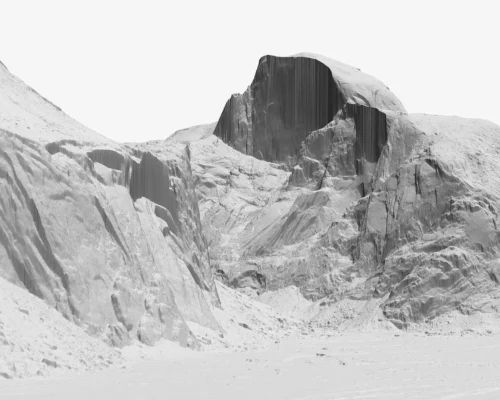
    Dan Holdsworth’s work Transmission: New Remote Earth Views (2012) uses data taken from USGS topographical laser scans which are usually used to measure changes in the land and climate. From this data, Holdsworth produces crisp, stark images that are devoid of life, giving a scientific view of his chosen landscapes.

    ‘Stripped of surface detail there are no signifiers of a natural wilderness or picturesque aesthetic, no invoking of the Romantic Sublime; and yet at the same time what is antithetical to these visual tropes – the man-made, the artificial, the vernacular of the New Topographics photographers – is also absent’ (Lewis n.d).

    What we are being presented with is a rendered image, a simulation of a real, recognisable landscape, but not a photograph of one. As Jean Baudrillard writes ‘Simulation […] is the generation by models of a real without origin or reality: a hyperreal’ (Baudrillard 2001). This theory of simulation is illustrated by Holdsworth in the form of scientific data displayed with the aesthetics of landscape photography. However, I would argue that this isn’t convergence as Henry Jenkins suggests: ‘Where old and new media collide, where grassroots and corporate media intersect, where the power of the media producer and the power of the media consumer interact in unpredictable ways’ (Jenkins 2008).  Holdsworth’s work is ‘new media’, but there is no old media to converge with. It’s digital technology mixing with digital data. Applied to the following example, Jenkins’ theory seems outdated, but remix could apply as it’s taking different media forms and creating new genres. In this instance, it is an example of post-landscape photography, combining the aesthetic of landscape photography with that of scientific datasets, producing a hyperreal simulation of the real world in order to realise the artist’s intent, one that couldn’t be achieved through material photography.

    Figure 1: Holdsworth 2012

    This data-driven simulated image allows Holdsworth to position the viewpoint from any angle in his simulated world. In Yosemite: C6 (figure 1) Holdsworth has mirrored the viewpoint of Ansel Adams’ Half Dome, Cottonwood Trees (figure 2). With the unlimited viewpoints that a digital rendering can offer, it’s interesting that Holdsworth has used a similar view to Adams’, who was famous for his Romantic views of Yosemite. It may be that because of the unlimited views available it’s easier to keep to a persistent visual language, choosing views that are closer to what we would experience as a viewer within the environment in order to be less incongruous.

    Figure 2: Adams 1932

    The nature of Holdsworth’s images mean that they are devoid of any markers such as trees or natural elements to give an idea of scale or perspective such as atmosphere, creating a distorted image that is initially hard to figure out. This has the effect of creating an other-worldly view, similar to images sent back from the moon or asteroids, but of a familiar place that we recognise from traditional landscape images. This distortion causes the viewer to consider why the work has been presented this way, rather than from a more familiar view such as Adams’.

    As critic Emma Lewis writes, ‘Holdsworth is working outside of the wilderness myths that render the photographic avant-garde the ‘after’ to Watkins and Ansel Adams’ ‘before’. (Lewis n.d.) This in some respect highlights the use of post-photography, or post-landscape photography, to work outside of conventional displays of a familiar landscape and reveal to us versions of them that we are unable to see in reality, presenting a critical, scientific view, free from romanticism. Tim Ingold suggests that landscape is, ‘not a picture in the imagination […] nor an alien and formless substrate awaiting the imposition of the human order’ (Ingold 1993). I would argue that the Postdigital has allowed us to visually construct imaginary landscapes, and that Holdsworth’s images have a stronger visual impact due to the lack of natural elements, questioning how we interpret and understand such images.

    David Thomas Smith

    David Thomas Smith’s project, Anthropocene, uses data taken from satellite photos on Google Maps of locations that have globally significant ‘social, economic or political importance in the world’ (Smith in Shore 2014). The term Anthropocene is recent term coined to define the next geological epoch as one that has been altered through human impact on the earth (Stromberg 2013) and Smith’s images reflect this in his choice of locations.

    ‘Anthropocene itself reflects upon the complex structures that make up the centres of global capitalism, transforming the aerial landscapes of sites associated with industries such as oil, precious metals, consumer culture, information and excess’ (Smith, 2013).

    To create his images, Smith combined thousands of screenshots from Google to create a high-resolution image, which is then mirrored horizontally and vertically to create a pattern that is similar in style to those of Persian carpets. Smith’s other inspiration was Afghan War rugs made during the 1980’s Soviet occupation, where Afghani women would document the volatile culture, creating ‘objects that contained and recorded a particular history’ (Smith in Shore 2014). Smith makes an interesting comparison to Persian and Afghan rugs, aulthough I wouldn’t immediately make the connection. I feel Three Gorges Dam (figure 3) and Beijing Airport (figure 4) are the closet to the aesthetic of a Persian rug, especially the sinuous nature of the road system and natural forms. The process of creating the images from thousands of small screen shots to manually create a larger image, 1.8m x 1.2m, is similar to the rug weavers using individual threads to construct a rug and makes the work more labour intensive than its digital nature would otherwise suggest. Smith classes his work as documentary photography. In my opinion, I consider the work also landscape photography, as it’s presenting a narrative of human impact in the landscape, but in a more aesthetically pleasing way than more hard-line documentary photography.

    Figure 3: Smith 2010

    Figure 4: Smith 2010

    Comparing Smith’s Three Gorges Dam (figure 3) with Nadav Kander’s Three Gorges Dam VI Yichang, Hubei Province, (figure 5) it is easy to see the main benefit of the satellite image. It shows a huge area of land giving the viewer a sense of scale that would be impossible with traditional photography. This ‘God’s Eye View’ (Sturken and Cartwright 2009) gives a detached, remote viewpoint, but one that is also very contemporary and familiar to a Postdigital society;

    ‘[Satellite] images are part of the history of modernity and visuality, in which an early fascination with photography was organized around a fascination with technologies for seeing things too small, too far away, or to hidden for the unaided human eye to see’ (ibid).

    Kander’s image, while also a photograph of the Three Gorges Dam, is a lot more humanistic. Like Ansel Adams picture of Yosemite, the image conforms to our own ideas of how a picture of a landscape should look, and the inclusion of the people sat on the rock embankment makes the viewer feel more connected. Both images show the impact this hydroelectric project has had on the environment, but with Kander, we are reminded how this has impacted on the human population.

    Figure 5: Kander 2007

    While Donna Haraway is critical of the term Anthropocene, which ‘obtained purchase in popular and scientific discourse in the context of ubiquitous urgent efforts to find ways of talking about, theorizing, modelling, and managing a Big Thing called Globalization’ (Haraway 2016), I feel that Smith’s project does highlight the human impact on the earth, and how humans have manipulated the natural environment for their own benefit in a global context. I would argue Smiths images do represent an understanding the Anthropocene, even if his use doesn’t quite fit into contemporary academic thinking. These images are closer to traditional photography than Holdsworth’s computer generated images, and as such could be better received by a wider audience looking at them from an aesthetic point of view. I would also say that they’re not an example of convergence in Jenkins’ sense as digital photography, satellite images and the distribution of them have already converged, but I do see it as a remix as it’s using appropriated images in a way that is mixing post-photography with a material aesthetic from the materiality of Afghan and Persian rugs.

    Digital Technologies

    The digital technologies that Holdsworth and Smith used to create their images have only existed for a short time. In Smith’s case, the freely available satellite images that can be appropriated and remixed, allow artists to explore issues such as the human impact on the environment or privacy. Satellite images allow the artist to capture views from the Middle East, Siberia, or China, without having to visit them. While this apparent democratisation of data could be the underlying foundation of post-convergent or remix culture, the data still has to be collected and distributed.

    Google is a global technology giant with the resources to map the world, but this brings up important questions on the display and use of this data. However, government-level censorship may exist as Google could be obliged to manipulate sensitive areas from county to country. Maps are a powerful political tool created by governments to control their borders. Satellite photography is now available to nearly everyone with an internet connection, undermining the politics of borders and governments, except those under strict state control such as China, where private surveying and mapping is illegal.

    Google watermark their satellite images to protect their IP, and this could be considered a form of ownership of the world, or at least the simulated world that exists in Google Maps. If Google own the images, then work produced from these images could be termed appropriation, such as Marcel Duchamp’s L.H.O.O.Q (1919) or Sherrie Levine’s series After Walker Evans (1981). Appropriation is one key aspect to post-photography but also calls into question the notion of author and copyright: who owns the rights to the work. The appropriation of digital data and the remix of it into new forms of artwork shifts power relations away from media producers such as Google, or the original content creators, towards those of the artist as the disseminator of this information, albeit curated. This changes the point of reception from those using satellite data for its intended purpose, to a new audience in the form of a material artwork that people experience.

    Appropriation is nothing new in art, and remix could be considered appropriation for the postdigital era. ‘Remix provides for new and interesting forms of artistry, challenges the established hierarchies of the culture industry, and demonstrates the way that creativity has always depended upon and borrowed from others’ (Gunkle 2018). Despite this appropriation, which Smith has noted that Google are aware of, it is still large corporations that have ultimate control over what data is released and is allowed (or appropriated) to be used. ‘Corporations – and even individuals within corporate media – still exert greater power than any individual consumer or even the aggregate of consumers’ (Jenkins 2006). In our age of litigation, one would need to be very careful of appropriation or remix, as large corporations control their own IP and copyright of the data.

    The Postdigital world has its foundations in the convergence of material and digital cultures. For example, the mobile phone converging with both video camera and computer which can be used to both record one’s thoughts and ideas, as well as broadcast or publish them through dedicated media outlets such as YouTube, Flickr, or Facebook. This allows anyone with an internet connection to take the data from one person or agency and remix this into a new form of artistic production.

    ‘Digital data may be copied without loss of quality, so it has become much easier for anyone to remix, recombine, and create new dependent works. […]. And as the digital network reaches anyone, the power relations have also been remixed, allowing anyone to be a creator, publisher, or broadcaster—or prod-user’ (Fagerjord 2009).

    This remixed data can then be uploaded, allowing artists to create their own platforms for sharing their work, free from galleries and curators. This unmoderated and un-curated art world could be an artistic free-for-all, with no authoritative voice to moderate what is put up. However, this practice becomes self-moderating, with people choosing what they want to look at with well-produced artworks becoming well-known or ‘viral’, allowing audiences all over the world to experience them. While everyone can be a creator or publisher, everyone is also now a curator and critic.

    Post-Convergence

    Post-convergence can consider the past convergence of media technologies as Jenkins proposed, alongside digitisation and remix culture in line with Fagerjord’s theory. It can also explain the divergence that has come about from Jenkins’ theory of convergence within our postdigital world. As Fagerjord states;

    ‘The concept of convergence is stretched beyond what is meaningful […] rather than converging into fewer technologies, companies, or genres, we are witnessing a proliferation of media; a divergence […] the consequences of digitalization’ (Fagerjord 2009).

    The evidence for this, Fagerjord argues, is that there are more genres of media around, and more being created than a convergent model would dictate. For example, post-landscape photography being a remix of traditional landscape photography, or its aesthetics, and post-photography, but creating a divergence away from traditional photography. To counter this, academic Anna Munster proposes a duality where both convergence and divergence can both apply;

    ‘We need to remind ourselves that the differential unfolding of new media — played out in this field of immersive and computer-mediated environments through the relations between the virtual propensities of information and the actualizations of information in concrete social-technical assemblages — can tend toward both convergence and divergence (Munster 2006).

    I would argue that we are experiencing post-landscape photography through post-convergence. Taking into consideration the digitised nature of production, including areas such as computer science, 3D modelling, the creation of simulated worlds, and remixing these digital technologies to create new forms of landscape images. As Clemens and Nash propose; ‘It is only with post-convergence that we realise that we are no longer – and therefore never have been – subject to predetermined parameters in art’ (Nash & Clemens 2010). Both Holdsworth and Smith are using digital technologies that that move on from Jenkin’s ideas of convergence. Using not only digital technology such as Google Maps, but scientific data such as laser scans and combing them with aesthetics that are tied to our current visual understanding of landscape photography.

    Conclusion

    Geographers Stephen Daniels and Denis Cosgrove wrote; ‘A landscape is a cultural image, a pictorial way of representing, structuring, or symbolising surroundings’ (Daniels and Cosgrove 1988). Landscape photography is the act of representing these surroundings through a literal photographic representation. The traditional photographic way of producing a landscape image will always have its place, certainly to depict an aesthetic and romantic point of view. But thinking of landscape photography in post-photographic terms, has to take into account post-convergence and remix. These terms are still quite new in photography discourse and have not had a chance to critically mature. Landscape photography has a long history in showing our natural environment and more recently how humans have encroached and changed it. By using digital technologies through post-photography to show landscapes, we are more able to re-structure our view of them within the Postdigital world, offering new perspectives, both literally in the form of satellite views and through the interpretation of scientific data such as Dan Holdsworth’s images.

    How landscape photography moves forward within post-photography and post-convergence depends on the artists ideas and technologies available, but these are constantly changing. The digital data used calls into question ownership and appropriation, but while there is precedent for appropriation in art, artists do tread a fine line. If the technology is available, then should this be viewed as a data free-for-all? If too many people start to use this, then this data could become monetized, making the idea of post-landscape photography only available to those who can afford it. Landscape photography has always been a genre that can bring aesthetic pleasure to many, but it also raises important questions on ecology and the environment in an ever more globalised world.

    In order to be relevant, landscape photographers and artists need to embrace a transdisciplinary approach to technology and search out new ways of highlighting contemporary issues, using data that illustrates more than can be seen with our own eyes. ‘Photography is above all else a medium of witness, a self-effacing window onto the world which is primarily concerned with recording that thing to which we breezily refer as ‘reality’’ (Shore 2014). This notion of reality depends greatly on the artist and what they are presenting to us as a ‘reality’. There are many realities and many issues. One single reality isn’t enough. Landscapes seen through post-photography allow construction of new realities, those that we are unable to experience, but that we need to know about in order understand our material world. As Anna Munster states:

    ‘It will be up to artists, designers, technicians and new media activists of all shapes and sizes to create these with an eye for not simply new perceptual experiences but the production of new forms of social, political and ethical relationships’ (Munster 2006).

    As post-photography is new, its future use within the genre of landscape photography can only be suggested at by what has gone before. Some may argue that it can’t be classed as photography, certainly not in the traditional sense, but through remix the genres will overlap and quite often the result is a material photographic image. But post-photography may be the outlet that allows creative landscape practitioners, rather than landscape photographers, to create works of political and ecological importance though remixing digital technologies that have yet to be realised. I personally think that to highlight global problems in the future, post-landscape photography will move further away from traditional photography into the realms of Augmented Reality. This will allow individuals to experience, rather than view, landscapes using data remixed from many different disciplines and technologies to construct simulations rather than images of landscapes. These may keep to the visual cues and signs that we are used to, although in a Postdigital culture even these may end up being remixed.


    Image References

    ADAMS, A., 1932. Half Dome, Cottonwood Trees [online] Available from http://www.museumsyndicate.com/item.php?item=34479 [accessed 18/11/2019]

    HOLDSWORTH, D., 2012. Yosemite: C6 [online] available from https://www.danholdsworth.com/works/transmission/yosemite/9/ [accessed 18/11/2019

    KANDER, N., 2007.Three Gorges Dam VI Yichang, Hubei Province [online] available from https://www.nadavkander.com/works-in-series/yangtze-the-long-river/single#42 [accessed 19/11/2019]

    SMITH, D. T., 2010. Three Gorges Dam [online] available from https://www.david-thomas-smith.com/anthropocene [accessed 18/11/2019]

    SMITH, D. T, 2010. Beijing Airport [online] https://www.david-thomas-smith.com/anthropocene [accessed 18/11/2019]

    Bibliography

    ALEXENBERG, M., 2011. The Future of Art in a Postdigital Age: From Hellenistic to Hebraic Consciousness. Bristol: Intellect Books Ltd

    COSGROVE, D., & S. DANIELS, 1988. The Iconography of Landscape. Cambridge: Cambridge University Press

    FAGERJORD, A., 2010. After Convergence: Youtube and Remix Culture. in J. HUNSINGER et al, International Handbook of Internet Research. Netherlands: Springer

    GUNKEL, D.J., 2018. Remixology: An Axiology for the 21st Century and Beyond. Found Footage Magazine, (4), pp. 52-59.

    HARAWAY, D., 2016. Tentacular Thinking: Anthropocene, Capitalocene, Chthulucene. e-flux journal. 75

    INGOLD, T., 1993. The Temporality of the Landscape. World Archaeology, 25(2), 152-174

    JENKINS, H., 2008. Convergence Culture: Were Old and New Media Collide. New York: New York University Press

    LEWIS, E., nd. Transmission: New Remote Earth Views. Dan Holdsworth [online] available from: https://www.danholdsworth.com/texts/transmissionnewremoteearthviews/ [accessed 18/11/2019]

    MARTIN, F., 2017. Post-Photography: The Artist with a Camera. Aesthetica Magazine [online] available from: https://www.aestheticamagazine.com/post-photography/ [accessed 23/11/2019]

    MUNSTER, A., 2006. Materializing New Media: Embodiment in Information Aesthetics. Dartmouth: University Press of New England

    NASH, A., and J. CLEMENS, 2010. Seven Theses on the Concept of ‘Post-Convergence’ [online] available from https://www.academia.edu/27057333/Seven_theses_on_the_concept_of_post-convergence [accessed 26/11/2012]

    SHORE, R., 2014. Post-photography: The Artist with a Camera. London: Laurence King Publishing

    SMITH, D. T., 2013. Anthropocene. [online] available from: https://www.thecopperhousegallery.com/usr/library/documents/main/anthropocene-works.pdf [accessed 23/11/2012]

    STROMBERG, J., 2013. What Is the Anthropocene and Are We in It? [online] available from: https://www.smithsonianmag.com/science-nature/what-is-the-anthropocene-and-are-we-in-it-164801414/ [accessed 27/11/2019]

    STURKEN, M. and L. CARTWRIGHT, 2009. Practices of Looking: An Introduction to Visual Culture. 2nd ed. New York: Oxford University Press

  • Film Photography is not dead

    Film Photography is not dead

    Is Film Photography Dead? (No).

    Film photography. I’m lucky/old enough to remember film well. I started out on my photographic adventures with my fathers Contax 139 and a few rolls of XP2 way back in 1998, taking photos of my friends mountain biking. Back then the only choice was what film to use, then the three day wait to see if what you’ve photographed actually turned out ok. Digital turned the photo-world upside down. It made the learning curve quicker and easier with instant feedback. It levelled the playing field and allowed everyone to be able to take a half-decent image.

    Many were saying that digital would spell the end of film but it could never match up with the quality, spawning the ongoing film vs digital debate. Indeed, lots of film stocks have now been discontinued as companies make the shift into more profitable areas. However, in recent years film has started to have a resurgence. Is this simply nostalgia for a past golden age, or is this the start of a new, more sustainable chapter in the story of photography?

    (more…)